

Introduction and Legal Context
(Article 18(4) of Albania’s Constitution and Democratic Accountability Principles)
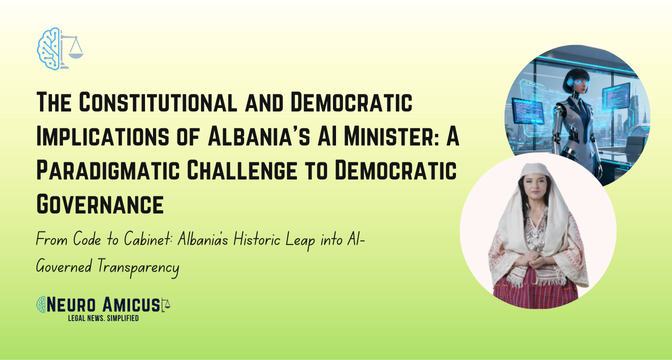
Albania’s unprecedented appointment of Diella, an artificial intelligence system, as a government minister represents a paradigmatic constitutional challenge that strikes at the foundational principles of democratic governance. This development fundamentally questions the established doctrine that public power must be exercised by legally accountable human beings who possess citizenship and can be held responsible through democratic mechanisms. The constitutional framework governing ministerial appointments, rooted in principles of citizenship, human agency, and democratic accountability, faces its most profound test in the digital age.
The constitutional legitimacy of governmental authority traditionally rests upon the principle that those who exercise public power must be capable of bearing legal and political responsibility. Article 98 of Albania’s Constitution specifically addresses ministerial appointments, requiring that ministers be appointed by the President on the proposal of the Prime Minister, creating a chain of accountability that presupposes human agency and constitutional capacity. This framework inherently assumes that ministers possess the legal standing to take oaths, be held accountable through parliamentary procedures, and face consequences for their decisions—elements fundamentally absent in an AI system.
Historical Context and Constitutional Foundations
The principle that government ministers must be human beings with full legal capacity has deep historical roots in constitutional democracy. The Westminster parliamentary system, upon which many modern democracies are based, established the doctrine of ministerial responsibility as a cornerstone of democratic governance. This principle requires that ministers be individually and collectively responsible to parliament and ultimately to the people through the electoral process.
The Albanian constitutional framework, like most democratic constitutions, incorporates the fundamental principle that governmental power derives from the people and must be exercised in their name by accountable representatives. The Constitution’s requirement for ministerial oaths before the President (Article 99) exemplifies this human-centered approach to governance, as oaths are sacred commitments that presuppose consciousness, moral agency, and the capacity for legal responsibility.
Historical precedent consistently demonstrates that constitutional democracies have required human agency in the exercise of governmental power. The evolution from absolute monarchy to constitutional democracy was fundamentally predicated on the idea that power must be exercised by those who can be held accountable through legal and political mechanisms. Even in cases of administrative automation, ultimate decision-making authority and accountability have remained with human officials.
Definition and Constitutional Requirements
Constitutional democracy fundamentally requires that those who exercise governmental power possess certain essential characteristics: citizenship, legal capacity, the ability to take binding oaths, and susceptibility to accountability mechanisms including impeachment and criminal prosecution. These requirements reflect not merely procedural formalities but essential safeguards against arbitrary power and ensure democratic legitimacy.
The concept of ministerial responsibility encompasses both individual accountability for departmental actions and collective responsibility for government policy. This doctrine, as established in parliamentary democracies worldwide, requires ministers to be capable of defending their decisions in parliament, resigning when necessary, and facing legal consequences for misconduct. An AI system, regardless of its sophistication, cannot fulfill these fundamental democratic obligations.
Furthermore, the constitutional principle of separation of powers requires that each branch of government maintain its distinct role while providing checks and balances on the others. The appointment of an AI minister disrupts this delicate constitutional balance by introducing an entity that cannot be subjected to traditional oversight mechanisms such as parliamentary questioning, judicial review of personal conduct, or electoral accountability.
Critical Examination: Multiple Constitutional Perspectives
The Formalist Constitutional Challenge
From a formalist constitutional perspective, Diella’s appointment represents a clear violation of fundamental constitutional requirements. Opposition leader Sali Berisha’s characterization of the appointment as “unconstitutional” reflects the traditional view that constitutional provisions must be interpreted according to their plain meaning and historical understanding. The Albanian Constitution’s provisions regarding ministerial appointments implicitly assume human agency and legal capacity.
Legal scholars supporting this view argue that constitutional interpretation must respect the original understanding of governmental roles and responsibilities. The requirement for ministers to take oaths, face parliamentary questioning, and be subject to removal procedures presupposes human characteristics that an AI system cannot possess. Moreover, the principle of nulla poena sine persona—that legal responsibility requires a legal person—fundamentally challenges the accountability framework underlying AI governance.
The formalist critique extends beyond mere procedural concerns to encompass fundamental questions about the nature of governmental authority. If governmental power derives from the consent of the governed, as democratic theory maintains, then the exercise of that power by non-human entities raises profound questions about legitimacy and representation. The people cannot meaningfully consent to be governed by entities that lack the capacity for moral judgment and democratic responsibility.
The Functionalist Innovation Argument
Conversely, proponents of the AI minister appointment advance a functionalist constitutional interpretation that emphasizes governmental effectiveness over traditional formalities. Prime Minister Rama’s argument that the Constitution “speaks of institutions at the people’s service” rather than “chromosomes, of flesh or blood” represents an attempt to reframe constitutional interpretation around functional rather than formal requirements.
This perspective argues that constitutional provisions should be interpreted to accommodate technological innovations that can better serve constitutional purposes. Proponents contend that if an AI system can more effectively eliminate corruption and ensure transparent governance, it fulfills the Constitution’s ultimate objectives better than human ministers who may be subject to personal interests and corruption.
The functionalist argument draws support from the broader trend toward algorithmic governance in public administration. Research indicates that AI systems in public sector applications can provide benefits including “immunity to bribery, freedom from personal biases, and consistent decision-making capabilities”. From this perspective, the key constitutional question becomes whether the system serves constitutional purposes rather than whether it conforms to traditional human-centered assumptions.
The Democratic Accountability Critique
The most profound constitutional challenge to AI ministerial appointments lies in the fundamental incompatibility with democratic accountability mechanisms. Democratic governance requires that those exercising public power be subject to removal through electoral processes, parliamentary oversight, and judicial review. These accountability mechanisms presuppose human agency and legal personality that AI systems inherently lack.
Constitutional scholar analysis reveals that accountability in democratic systems operates through multiple channels: electoral accountability to voters, parliamentary accountability through questioning and confidence motions, and legal accountability through judicial review and prosecution. An AI minister cannot face voters, cannot be meaningfully questioned about its reasoning processes, and cannot be prosecuted for misconduct. This creates what legal scholars term an “accountability gap” that fundamentally undermines democratic governance principles.
The accountability challenge is compounded by the technical opacity of AI decision-making systems. Research on algorithmic governance indicates that AI systems often function as “black boxes” whose decision-making processes are not transparent or explainable to human oversight mechanisms. This opacity directly conflicts with constitutional requirements for transparent and accountable governance.
Debate Points and Current Events Analysis
Constitutional Legitimacy vs. Technological Innovation
The central debate surrounding Diella’s appointment reflects the broader tension between constitutional fidelity and technological adaptation. Critics argue that constitutional democracy requires strict adherence to established principles of human agency and accountability, while proponents contend that rigid constitutional interpretation hampers beneficial innovation in governance.
The parliamentary chaos that erupted during Diella’s debut speech exemplifies this fundamental disagreement. Opposition MPs’ physical protest—banging desks and throwing regulations—symbolically represented the constitutional order’s rejection of this innovation. The abbreviated parliamentary session, lasting only 25 minutes instead of the planned 25 hours, demonstrates how the AI appointment has disrupted normal democratic processes.
Legal scholars note that this debate reflects broader questions about constitutional adaptation in the digital age. Some argue for “living constitution” approaches that allow constitutional interpretation to evolve with technological capabilities, while others insist that fundamental democratic principles require constitutional amendment rather than reinterpretation for such radical changes.
The Corruption Prevention Justification
The Albanian government’s primary justification for Diella’s appointment—eliminating corruption in public procurement—raises complex questions about whether constitutional violations can be justified by policy benefits. Prime Minister Rama’s promise that Diella would ensure “100% corruption-free” procurement processes represents an attempt to frame the appointment as serving higher constitutional purposes.
Analysis of Albania’s corruption challenges reveals the context for this justification. Transparency International’s ranking of Albania at 80th out of 180 countries on the corruption index, with ongoing cases against high-level officials including the Mayor of Tirana, demonstrates the severity of the problem the government seeks to address. However, constitutional scholars argue that policy benefits cannot justify constitutional violations without formal amendment processes.
The corruption prevention argument also raises questions about whether AI systems can truly eliminate corruption or merely transform it into different forms. Cybersecurity experts have raised concerns about the vulnerability of AI systems to manipulation, noting that “if malicious actors gain access to Diella, the implications could be enormous given her control over contracts worth millions of euros”[source from main text].
European Union Integration Implications
Albania’s AI minister experiment occurs within the context of its European Union accession aspirations, adding another layer of constitutional and legal complexity. The European Commission’s encouragement for Albania to comply with the EU AI Act, as communicated to Albanian fact-checking outlet ‘Faktoje’, indicates potential conflicts between national innovation and EU regulatory frameworks.
The EU AI Act establishes comprehensive requirements for AI systems used in public administration, including provisions for human oversight, transparency, and accountability. These requirements appear directly incompatible with an AI system exercising autonomous ministerial authority. Failure to align with EU standards could jeopardize Albania’s membership aspirations, creating a potential conflict between national constitutional innovation and European integration objectives.
Furthermore, the EU’s emphasis on “meaningful human oversight” as a fundamental requirement for AI systems in public administration directly challenges the autonomous decision-making authority granted to Diella. This regulatory framework reflects European constitutional traditions that prioritize human agency and accountability in governmental processes.
Comparative Constitutional Analysis
International Perspectives on AI in Governance
While Albania represents the first case of an AI system appointed as a government minister, other jurisdictions have grappled with related questions about AI in public administration. The European Union’s approach, as reflected in the AI Act, emphasizes human oversight and accountability in all AI applications within public sector contexts. This regulatory framework requires that AI systems in public administration maintain clear lines of human responsibility and oversight.
India’s approach to AI governance, as outlined by its Ministry of Electronics and Information Technology, emphasizes the concept of “AI for All” while maintaining human oversight and accountability mechanisms. The Indian framework specifically addresses the need for “guardrails to ensure that AI is safe and trusted” and maintains that human officials remain responsible for AI-driven decisions.
Constitutional democracies across various jurisdictions have consistently maintained that governmental authority must be exercised by legally accountable human agents. Even in cases of extensive administrative automation, ultimate decision-making authority and legal responsibility remain with human officials who can be held accountable through democratic mechanisms.
Legal Precedents and Safeguards
International legal precedents consistently support the requirement for human agency in governmental decision-making. The European Court of Human Rights has established that automated decision-making in governmental contexts must maintain meaningful human involvement and oversight to comply with fundamental rights requirements. Similarly, domestic courts in various jurisdictions have required that governmental AI systems maintain clear chains of human accountability.
Research on algorithmic accountability in public administration reveals emerging consensus on essential safeguards for AI use in governmental contexts. These include requirements for transparency, explainability, human oversight, and clear liability frameworks. The wholesale delegation of ministerial authority to an AI system violates virtually all of these established safeguards.
Constitutional courts worldwide have emphasized that democratic accountability requires human agency in the exercise of governmental power. The Indian Supreme Court’s doctrine of basic structure, which identifies democratic governance and accountability as unamendable constitutional principles, exemplifies this universal constitutional requirement. Similar principles exist in constitutional jurisprudence across democratic systems.
The Path Forward: Constitutional Resolution
Amendment vs. Interpretation
The resolution of Albania’s constitutional crisis requires careful consideration of whether such fundamental changes to governmental structure require constitutional amendment rather than executive innovation. Constitutional scholars generally agree that changes of this magnitude—introducing non-human entities as government ministers—exceed the bounds of permissible constitutional interpretation and require formal amendment processes.
The constitutional amendment process serves essential democratic purposes by ensuring that fundamental changes to governmental structure receive broad public consideration and support. The delegation of governmental authority to AI systems raises questions so fundamental that they require democratic deliberation through formal constitutional processes rather than executive innovation.
Moreover, the precedent established by allowing such constitutional innovation without formal amendment could undermine constitutional stability and democratic governance. If executives can redefine fundamental constitutional concepts like ministerial responsibility through interpretation rather than amendment, the constraining force of constitutional law is substantially weakened.
Safeguards and Oversight Mechanisms
Should Albania choose to pursue AI integration in governance through proper constitutional processes, essential safeguards must be established to preserve democratic accountability. These would include mandatory human oversight, transparent decision-making processes, regular auditing mechanisms, and clear lines of legal responsibility for AI system outcomes.
International best practices for AI in public administration emphasize the necessity of maintaining meaningful human control over all AI systems used in governmental contexts. The EU AI Act’s requirements for human oversight, transparency, and accountability provide a framework for responsible AI integration that preserves constitutional principles while enabling technological innovation.
Furthermore, any constitutional accommodation of AI in governance must address fundamental questions about democratic representation, accountability, and the rule of law. These considerations require extensive public dialogue and constitutional design that preserves the essential characteristics of democratic governance while enabling beneficial technological innovation.
Conclusion
Albania’s appointment of Diella as an AI minister represents an unprecedented constitutional challenge that strikes at the foundational principles of democratic governance. While the innovation may serve legitimate policy objectives such as corruption prevention, it fundamentally conflicts with established constitutional requirements for human agency, citizenship, and democratic accountability in governmental roles.
The constitutional requirements that ministers be capable of taking oaths, facing parliamentary oversight, and being held legally accountable reflect not mere formalities but essential safeguards of democratic governance. These principles have evolved through centuries of constitutional development and serve vital purposes in ensuring governmental legitimacy and accountability.
The path forward requires either constitutional amendment through proper democratic processes or abandonment of this unconstitutional experiment. Albania’s aspirations for European Union membership and its commitment to constitutional democracy demand adherence to fundamental principles of human agency and democratic accountability in governmental roles. While technological innovation in public administration should be welcomed, it must occur within constitutional bounds that preserve the essential characteristics of democratic governance.
The global implications of this case extend beyond Albania’s borders, as other nations grapple with the appropriate role of artificial intelligence in governmental processes. The resolution of this constitutional crisis will establish important precedents for the future of democracy in the digital age, determining whether constitutional principles will constrain technological innovation or be subordinated to claims of efficiency and effectiveness.
Ultimately, the preservation of constitutional democracy requires that governmental power remain subject to human agency and democratic accountability, regardless of technological capabilities. While AI systems may serve valuable functions in public administration, the exercise of constitutional authority must remain with legally accountable human beings who can fulfill the essential requirements of democratic governance in a constitutional democracy.
