

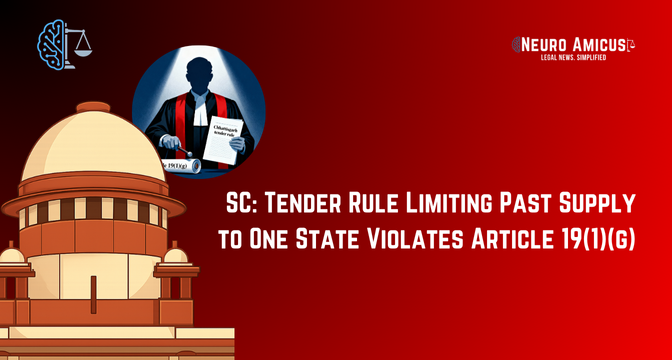
The Supreme Court of India delivered a landmark ruling on October 6, 2025, declaring that tender conditions restricting participation to bidders with prior supply experience within a specific state are constitutionally invalid. The Court held that such restrictions violate Article 14 (equality before law) and Article 19(1)(g) (freedom to practice any profession, occupation, trade or business) of the Constitution. The ruling emphasized that public procurement must ensure fair competition and uphold the “doctrine of level playing field,” rejecting artificial barriers that favor local suppliers while excluding competent national competitors.
Legal Provisions Relied On
Article 14 of the Constitution of India, 1950
Verbatim Text: “The State shall not deny to any person equality before the law or the equal protection of the laws within the territory of India.”
Explanation: Article 14 ensures that all individuals receive equal treatment under the law without discrimination based on arbitrary grounds. It embodies both negative equality (equality before law) and positive equality (equal protection of laws).
Relevance to News: The Supreme Court found that the tender condition violated Article 14 by creating discriminatory treatment between suppliers based solely on their past dealing history with Chhattisgarh government agencies, lacking rational nexus with the contract’s objectives.
Article 19(1)(g) of the Constitution of India, 1950
Verbatim Text: “All citizens shall have the right to practise any profession, or to carry on any occupation, trade or business.”
Explanation: This fundamental right guarantees citizens the freedom to engage in any lawful economic activity, subject only to reasonable restrictions under Article 19(6) that must be in the interest of the general public.
Relevance to News: The Court held that the impugned tender condition created an unreasonable restriction on trade by artificially limiting participation based on geographical past performance, thereby violating the freedom of trade guaranteed under Article 19(1)(g).
Article 301 of the Constitution of India, 1950
Verbatim Text: “Subject to the other provisions of this Part, trade, commerce and intercourse throughout the territory of India shall be free.”
Explanation: Article 301 ensures free flow of trade, commerce and intercourse across state boundaries to maintain economic unity and prevent inter-state trade barriers.
Relevance to News: Though not extensively discussed in this case, Article 301 supports the broader constitutional framework protecting freedom of trade across state boundaries, reinforcing the Court’s reasoning against state-specific tender restrictions.
Core Legal Topic
Public Procurement Law and Constitutional Principles of Equality in Government Contracting
The core legal topic encompasses the intersection of public procurement regulations with fundamental constitutional rights, specifically focusing on how tender conditions must comply with principles of equality, non-discrimination, and freedom of trade. This includes the judicial review of government contracting decisions to ensure they meet constitutional standards of reasonableness and fairness while promoting competitive bidding processes.
How Does the Law Work in Practice, and What Are the Key Principles?
Abstract
Public procurement in India operates within a constitutional framework that mandates adherence to principles of equality, transparency, and fair competition. The Supreme Court’s intervention in Vinishma Technologies Pvt. Ltd. v. State of Chhattisgarh represents a critical examination of how tender conditions must balance legitimate governmental interests with constitutional guarantees of non-discrimination and freedom of trade. This case addresses the fundamental tension between allowing procurement authorities discretion in setting eligibility criteria and preventing the creation of artificial barriers that favor local suppliers over competent national competitors. The ruling establishes important precedents for ensuring that public procurement serves the public interest through genuine competition rather than protectionist policies that may ultimately harm the public exchequer and violate constitutional principles.
Background and Context
The evolution of public procurement law in India reflects the country’s transition from a planned economy to a more liberalized market system following the 1991 economic reforms. Initially, government procurement was largely insulated from judicial review, with courts reluctant to interfere in what were considered purely contractual matters. However, landmark decisions such as Ramana Dayaram Shetty v. International Airport Authority of India (1979) established that state actions in contractual dealings must comply with constitutional principles of equality and non-arbitrariness. The development of the “doctrine of level playing field” through cases like Reliance Energy Ltd. v. Maharashtra State Road Development Corporation Ltd. (2007) further refined the constitutional framework governing public procurement, emphasizing that Article 19(1)(g) requires equal opportunities for all competent bidders. This jurisprudential evolution reflects India’s commitment to ensuring that public resources are utilized efficiently through transparent and competitive processes while preventing discrimination and favoritism in government contracting.
Definition and Scope
Public procurement refers to the process by which government entities acquire goods, services, or works from private suppliers through competitive bidding mechanisms. The constitutional framework governing such procurement encompasses several key principles: the requirement for equality and non-discrimination under Article 14, the protection of freedom of trade under Article 19(1)(g), and the broader mandate for rational and non-arbitrary state action. The “doctrine of level playing field” emerges from these constitutional provisions and requires that all equally placed competitors receive fair opportunities to participate in government tenders. The scope of judicial review in procurement matters extends to examining whether tender conditions are arbitrary, discriminatory, or lack rational nexus with legitimate governmental objectives, while generally deferring to administrative discretion in technical and commercial matters.
Statutory Framework
India’s public procurement framework operates through a combination of constitutional provisions, statutory enactments, and administrative rules. The Constitution provides the foundational framework through Articles 14, 19(1)(g), and 301, which establish the principles of equality, freedom of trade, and free commerce respectively. The General Financial Rules (GFR) and various procurement policies such as the Public Procurement (Preference to Make in India) Order, 2017, provide detailed guidelines for procurement processes. State-level tender acts and rules further regulate procurement procedures, emphasizing transparency, competitiveness, and value for money. The Supreme Court has consistently held that while procurement authorities enjoy considerable discretion in framing tender conditions, such discretion must be exercised within constitutional bounds and cannot create arbitrary or discriminatory barriers.
Sub-Themes and Components
Judicial Review Standards: Courts apply a limited but meaningful review standard in procurement matters, intervening only when tender conditions are “wholly arbitrary, discriminatory or actuated by malice”. This standard balances administrative autonomy with constitutional compliance.
Doctrine of Level Playing Field: This principle requires that tender conditions provide equal opportunities for all competent bidders without creating artificial barriers. It finds expression in Article 19(1)(g) and serves to prevent the skewing of markets in favor of particular suppliers.
Reasonable Restrictions: While Article 19(1)(g) guarantees freedom of trade, such freedom is subject to reasonable restrictions under Article 19(6). However, restrictions must be in the interest of the general public and cannot be arbitrary or excessive.
Local Content and Preference Policies: Government policies promoting domestic manufacturing must be implemented without violating constitutional principles of equality and freedom of trade. Such policies must maintain rational nexus with their objectives and avoid discriminatory implementation.
Critical Analysis Context
The tension between promoting local suppliers and maintaining constitutional compliance reveals several challenges in India’s procurement framework. While legitimate policy objectives such as supporting domestic industry and ensuring reliable supply chains justify certain preferences, the implementation of such policies often creates artificial barriers that may ultimately harm public interest by reducing competition and increasing costs. The Supreme Court’s approach in the present case demonstrates judicial willingness to scrutinize procurement decisions that appear to favor particular suppliers without adequate justification. However, questions remain about the practical implementation of competitive procurement in sectors where local knowledge or specialized experience may genuinely matter, and the challenge of distinguishing between legitimate technical requirements and disguised protectionism continues to evolve through judicial precedent.
Judicial Interpretation
The Supreme Court’s jurisprudence on public procurement has evolved significantly since the foundational Ramana Dayaram Shetty case, establishing a sophisticated framework for balancing administrative discretion with constitutional compliance. In Tata Cellular v. Union of India, the Court established that judicial review in tender matters should be limited to preventing arbitrariness, irrationality, and mala fides, while generally respecting the technical expertise of procurement authorities. The landmark Reliance Energy decision introduced the “doctrine of level playing field” as a constitutional requirement under Article 19(1)(g), emphasizing that tender conditions must provide “legal certainty” and avoid “vagueness or subjectivity” that could result in discriminatory treatment. In Global Energy Ltd. v. Adani Exports Ltd., the Court reiterated that “terms of invitation to tender are not open to judicial scrutiny unless they are wholly arbitrary, discriminatory or actuated by malice,” establishing the high threshold for judicial intervention. The present Vinishma Technologies case represents a significant application of these principles, with the Court finding that geographical restrictions on past performance violated both the equality principle under Article 14 and the freedom of trade under Article 19(1)(g). The Court’s reasoning demonstrates how artificial barriers that lack rational nexus with contract objectives can be struck down even when procurement authorities claim legitimate concerns about local conditions or specialized requirements.
Conclusion
The Supreme Court’s ruling in Vinishma Technologies establishes important precedents for constitutional compliance in public procurement, emphasizing that tender conditions must serve genuine public interests rather than protectionist agendas. The decision reinforces that while procurement authorities retain significant discretion in setting technical and commercial requirements, such discretion cannot be exercised to create artificial barriers that favor particular suppliers without rational justification. The practical implications include the need for procurement authorities to ensure that all tender conditions have demonstrable nexus with contract objectives and that geographical or local experience requirements are justified by specific technical or logistical necessities rather than mere administrative convenience. This ruling likely signals increased judicial scrutiny of tender conditions that appear to limit competition artificially, potentially requiring governments to demonstrate more compelling justifications for restrictive eligibility criteria in future procurement processes.
