

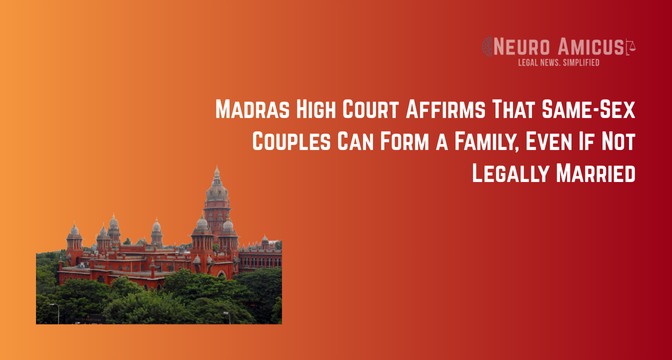
Chennai, June 4, 2025 — In a progressive judgment, the Madras High Court has held that same-sex couples can legally constitute a family, even though same-sex marriage is not currently recognized under Indian law. The decision was delivered by a division bench comprising Justice GR Swaminathan and Justice V Lakshminarayan while hearing a habeas corpus petition filed by a woman seeking the release of her partner who was allegedly detained by her own family.
Case Background and Court Observations
The petitioner approached the High Court claiming that her partner (referred to as the detenu) was being held against her will by her father. During the court proceedings, the detenu was produced in person and confirmed that she was a lesbian in a consensual relationship with the petitioner. She further revealed that she had been physically abused, forced to undergo rituals to “change” her sexual orientation, and denied her freedom.
The court noted that despite the Supreme Court’s judgment in Supriyo @ Supriya Chakraborty v. Union of India, which did not legalize same-sex marriages, the idea of “family” cannot be narrowly confined to heterosexual married couples. The judges emphasized that family should be interpreted in a broader, inclusive manner, especially in light of the evolving jurisprudence surrounding the LGBTQIA+ community.
“The expression ‘family’ has to be understood in an expanded sense. While Supriyo @ Supriya Chakraborty Vs Union of India (2023 INSC 920) may not have legalised marriage between same sex couples, they can very well form a family. Marriage is not the sole mode to found a family. The concept of ‘chosen family’ is now well settled and acknowledged in LGBTQIA+ jurisprudence. The petitioner and the detenue can very well constitute a family,” the court said.
Concerns Over Use of the Word “Queer”
The bench also took a moment to reflect on the language used to describe sexual minorities. It expressed discomfort with the use of the term “queer”, pointing out that the word commonly means “strange” or “odd,” which could imply negative connotations. The court emphasized that a homosexual individual’s sexual orientation should be seen as completely normal, and such labels should be used with care and sensitivity.
Question raised by bench: “We feel a certain discomfort in employing the expression “queer”. Any standard dictionary defines this word as meaning “strange or odd”. Queering one’s pitch means spoiling the show. To a homosexual individual, his/her/their sexual orientation must be perfectly natural and normal. There is nothing strange or odd about such inclinations. Why then should they be called as queer?”
Failure of Police and State Authorities
The Court severely criticized the police for their lack of action and insensitivity. Despite the petitioner sending multiple SOS messages and formal complaints, the police failed to intervene. The court held that such inaction was a violation of the rights of the LGBTQIA+ community, especially their right to security and personal liberty as affirmed by the Yogyakarta Principles and the Supreme Court’s landmark rulings in NALSA and Navtej Singh Johar cases.
“We censure the rank inaction and insensitivity of the police. The right to security is a fundamental right, and government officials are duty-bound to respond swiftly and appropriately to such complaints,” the judges stated.
Legal Recognition of Civil Unions
The bench also referred to a previous Madras High Court decision that recognized civil partnerships between same-sex individuals through a “Deed of Familial Association”. This provides an alternative legal acknowledgment of their union even in the absence of formal marriage laws.
Final Verdict and Continuing Mandamus
Honoring the detenu’s wishes to be with the petitioner, the court closed the habeas corpus plea and directed that her family must not interfere in her personal life. It also issued a continuing mandamus to the police, ensuring that protection is provided to the couple whenever required in the future.
Conclusion
This judgment reaffirms the fundamental rights of LGBTQIA+ individuals in India, especially their right to live with dignity, form familial bonds, and receive protection from the state. It emphasizes that while same-sex marriage may not yet be legally recognized, the legal system must protect and acknowledge non-traditional family structures.
