
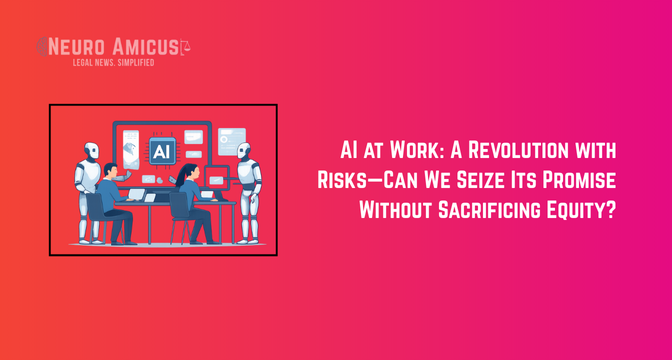
Is artificial intelligence the greatest workplace innovation of our time—or the next frontier for systemic bias and mass unemployment? As AI tools rapidly reshape hiring, evaluation, and day-to-day workflows, legal and ethical fault lines are beginning to emerge. The technology offers undeniable efficiencies: faster hiring, cost savings, and data-driven insights. But beneath the surface lies a complex and troubling question: Are we building a fairer, more productive future—or simply automating past injustices at scale?
Across industries, AI now filters résumés, scores interviews, and even determines promotion pathways. But algorithms are only as unbiased as the data and designs behind them. Consider Amazon’s now-infamous recruiting tool, which penalized candidates whose résumés included the word “women’s”—a reflection of historical male dominance in tech hiring. Or screening systems that downrank applicants from certain ZIP codes, inadvertently replicating racial exclusion. These are not science-fiction scenarios; they are documented realities of algorithmic discrimination already impacting thousands of job seekers.
Bias in AI hiring stems from three key sources: skewed historical data, opaque model logic, and unconscious design choices. Many algorithms are trained on past employment decisions—often rife with gender, racial, or socioeconomic disparities. Add to this the technical complexity of AI models, which makes external auditing difficult, and the picture becomes more concerning. If even developers struggle to explain how decisions are made, how can affected individuals contest unfair treatment? Is “explainability” in algorithmic hiring too much to ask—or the bare minimum in a rights-based society?
The risk, however, is not just discrimination. It is also dislocation. AI is expected to displace millions of jobs by 2030—from clerical and retail roles to paralegal and customer support positions. This is not fearmongering. It’s economic forecasting. While some jobs will be augmented or even created—AI specialists, data analysts, ethicists—the transition will not be seamless. Will displaced workers be offered meaningful retraining, or simply pushed aside in the name of “efficiency”? What safety nets will catch them, and who will pay for the re-skilling they need?
Yet to paint AI solely as a threat would be short-sighted. AI can democratize hiring—removing subjective biases, expanding applicant pools, and improving accessibility for disabled candidates. Tools that are thoughtfully designed, regularly audited, and deployed with human oversight can reduce rather than entrench inequality. This is where legal frameworks must rise to meet the moment.
Globally, the law is beginning to catch up. The European Union’s AI Act treats HR-related AI systems as “high risk,” mandating rigorous documentation and bias mitigation. In the U.S., the Equal Employment Opportunity Commission has warned employers about disparate impacts, and cities like New York now require bias audits for automated hiring tools. But fragmentation remains a problem. State-level laws differ wildly, creating compliance chaos for companies operating across jurisdictions. Who should bear responsibility when things go wrong—the tool developer or the employer using it? Can we afford this kind of legal ambiguity when livelihoods are on the line?
So how should organizations respond? First, by refusing to outsource moral judgment to machines. Human-in-the-loop models—where final decisions remain with trained personnel—are essential, not optional. Second, by demanding transparency from vendors and conducting independent audits of AI systems before deployment. And third, by advocating for harmonized federal legislation that offers both clarity and protection: clear liability rules, robust anti-discrimination standards, and mandatory reporting of AI outcomes.
Employers must also recognize their broader social responsibility. “Augmentation first” should be the guiding philosophy—using AI to enhance, not replace, human work. That means investing in upskilling, redesigning roles around human-AI collaboration, and ensuring no one is left behind in the rush toward automation. Could AI help workers find better, more meaningful work—or will it widen the gulf between the tech-savvy and the vulnerable?
Ultimately, the question is not whether AI belongs in the workplace. It already does. The real question is whether we can build systems that are efficient and equitable, innovative and inclusive. Are we willing to scrutinize what we automate, question who benefits, and legislate with foresight rather than afterthought?
The future of work is being written in code. Let us make sure that the law—our oldest technology of fairness—keeps pace.
