
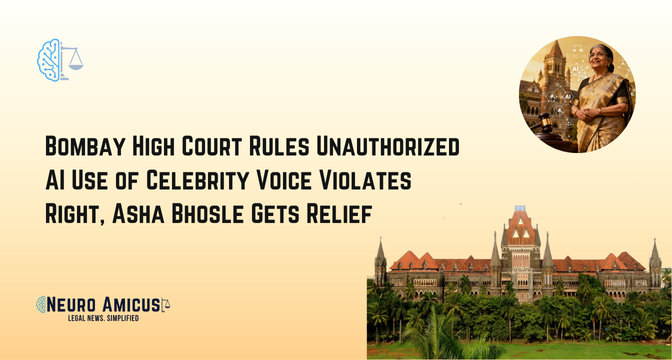
The Bombay High Court, in the case Asha Bhosle v. Mayk Inc., has granted interim relief to legendary singer Asha Bhosle against the unauthorised use of her voice and image by AI platforms and online sellers. Bhosle alleged that AI applications cloned her voice and that her likeness was misused for merchandise and online promotions without her consent. The Court held that such technological exploitation, especially through AI-generated replication, constitutes a violation of her personality and publicity rights, as well as her moral rights under copyright law. The Court restrained the defendants—including AI companies, online marketplaces, and YouTube—from using Bhosle’s voice, likeness, or image without authorisation, and directed the removal of the infringing content, affirming that such conduct causes irreparable harm to her reputation and goodwill.
Legal Provisions Relied Upon
Copyright Act, 1957, Section 38B
“The performer of a performance shall, independently of his right after assignment, … have the right to claim to be identified as the performer of his performance except where omission is dictated by the manner of the use of the performance; and … to restrain or claim damages in respect of any distortion, mutilation or other modification of his performance that would be prejudicial to his reputation.”
Explanation: Grants performers “moral rights”—including attribution and the right to object to derogatory treatment of their performances.
Relevance: Invoked to protect Bhosle’s control over her recorded performances, specifically against AI-driven distortions and misappropriations.
Common Law Tort of Passing Off, Article 21 (Right to Privacy), Article 19(1)(a) (Freedom of Expression) – Constitution of India
No explicit statutory wording, but courts recognise the right to publicity as flowing from the right to privacy and personality under Article 21, balanced against free speech. Judicial precedent protects a celebrity’s name, voice, likeness, and persona against misappropriation for commercial or deceptive use.
Relevance: Forms the foundation for protecting Bhosle’s personality/publicity rights from AI-powered misuse and commercial exploitation without her consent.
What Is the Main Legal Issue Addressed in This Case?
The core legal topics in this case are Personality and Publicity Rights and Performer’s Moral Rights under Copyright Law.
Personality and publicity rights refer to an individual’s ability to control the commercial and identity-based use of their name, voice, likeness, or image, especially relevant when a celebrity is targeted for commercial gain or misrepresentation by others.
How Does the Law Work in Practice, and What Are the Key Principles?
Personality Rights and AI Voice Cloning—Legal Protection for Celebrity Identity
The Challenge of Safeguarding Persona and Performers’ Rights in the Digital Era
Abstract
This case touches upon pivotal questions at the intersection of technology, intellectual property, and individual autonomy. The rise of AI tools capable of convincingly cloning voices and images has amplified risks to celebrities’ personality rights—rights that enable individuals, especially public figures, to determine how their identity attributes are used or commercialised. The objective here is to clarify how Indian laws, evolved primarily through judicial precedent rather than specific legislation, adapt to the complexities posed by AI-generated misappropriation, particularly as it infringes on moral and economic interests of creators. The central issues include whether existing IP and privacy frameworks adequately protect against AI-facilitated misuse, and where the balance should lie between free expression, commercial innovation, and personal dignity.
Background
Personality rights were historically enforced via common law doctrines of privacy and passing off, gaining constitutional footing through the Supreme Court’s expansion of Article 21 (right to privacy, R. Rajagopal v. State of Tamil Nadu). With technological advances, especially the proliferation of AI and deepfake tools, the risk of unauthorised digital exploitation of celebrity identities—via voice cloning, image morphing, unauthorised merchandise—has surged, prompting courts, as in the recent judgments involving Asha Bhosle, Arijit Singh, Aishwarya Rai Bachchan, and others, to craft evolving remedies that cover these new frontiers.
Definition & Scope
Personality/publicity rights: The right of an individual—particularly celebrities—to control the commercial use of their persona, including name, likeness, voice, image, and signature. Not expressly codified in Indian law but enforced through the constitutional right to privacy (Article 21), common law torts, and statutory moral rights (Copyright Act, 1957, Sections 38A and 38B).
Scope: These rights restrict others—especially commercial actors or AI platforms—from unauthorised use that causes commercial loss, confusion, or injury to reputation. They do not prohibit bona fide news reporting, parody, or non-commercial commentary, provided there’s no commercial exploitation or false endorsement.
Statutory Framework
- Copyright Act, 1957, Section 38B: Grants performers independent “moral rights”: attribution and protection against derogatory treatment/distortion—even after assignment of economic rights.
- Trade Marks Act, 1999: Allows for registration of personal names/traits as trademarks for commercial protection.
- Constitution of India, Articles 19(1)(a), 21: Courts have recognised the right to publicity and privacy, including the right “to be left alone” (R. Rajagopal, Puttaswamy cases), as part of Article 21; balanced against freedom of expression, but commercial or misleading exploitation receives little protection.
Understanding Sub-Themes
- Meaning and Constitutional Basis: Personality rights are rooted in the right to privacy and “right of publicity,” and have been enforced through both common law and Article 21.
- Reasonable Restrictions: Courts balance personality rights against Article 19(1)(a) free speech. Parody or news may be protected; commercial exploitation is not. AI-synthesised misuse is presumed commercial unless shown otherwise.
- Case Law Evolution: Indian courts (Bombay, Delhi HCs) have consistently expanded protection for celebrities, especially against AI misuse, unauthorised merchandise, or deepfakes—see the cases involving Asha Bhosle, Arijit Singh, Aishwarya Rai Bachchan, Amitabh Bachchan, Jackie Shroff, and others.
Critical Analysis and Judicial Interpretation
Indian law, though progressive in expanding protections via common law and constitutional interpretation, lacks a dedicated statute specifically addressing personality rights and AI. While the Copyright Act’s moral rights offer crucial protection for performers, gaps exist—in particular, for non-performance personality rights and lasting remedies against anonymous AI misuse or platforms based abroad. Enforcement is stronger against named parties but is challenged by cross-jurisdictional and digital anonymity barriers. Nevertheless, the courts’ willingness to move swiftly with takedown orders and dynamic injunctions reflects adaptability.
Recent years have seen significant judicial elaboration. The Bombay HC in Arijit Singh v. Codible Ventures LLP held that unauthorised AI-based replication of a celebrity’s voice constitutes a violation of both moral and publicity rights, and that free speech does not extend to commercial misappropriation via AI tools. The Delhi HC in Aishwarya Rai Bachchan v. Aishwaryaworld.com affirmed the right to control one’s digital persona and ordered immediate takedowns of unauthorised AI-generated content and merchandise. The landmark SC decision in R. Rajagopal v. State of Tamil Nadu grounded personality rights in Article 21, recognising the right to privacy and the “right to be let alone,” to be balanced against public interest and free expression.
In Asha Bhosle v. Mayk Inc., the Bombay High Court adopted and extended these principles, finding a strong prima facie case for interim relief, granting broad injunctive orders, and demonstrating a clear judicial trend to adapt the law to new technological threats. These precedents matter as they lay the foundation for future regulatory frameworks around AI-driven misuse of identity attributes and offer practical relief to affected celebrities in the absence of statutory intervention.
Conclusion
The Bombay HC’s ruling signals a robust judicial commitment to protect celebrity personality and moral rights from unauthorised AI-driven exploitation. Pending comprehensive legislative action, Indian courts will continue to innovatively adapt constitutional and IP frameworks to balance technological development, individual autonomy, and commercial interests—though practical enforcement challenges remain for online and cross-border violations.
