

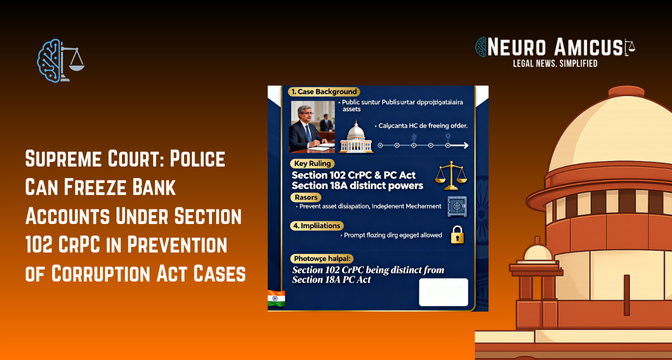
News summary
In State of West Bengal v. Anil Kumar Dey (2025 INSC 1413), the Supreme Court resolved a major controversy on whether investigating agencies can freeze a person’s bank accounts under Section 102 of the Code of Criminal Procedure in cases registered solely under the Prevention of Corruption Act, 1988. The case arose from a disproportionate assets investigation against a police officer in West Bengal, during which fixed deposits and bank accounts standing in the name of his 93‑year‑old father and other relatives were frozen, allegedly representing ill‑gotten wealth parked benami. The trial court refused to defreeze the accounts, but the Calcutta High Court, relying on Ratan Babulal Lath v. State of Karnataka, held that the PC Act is a self‑contained code and that attachment or freezing of bank accounts in corruption cases must proceed only under Section 18A PC Act read with the Criminal Law Amendment Ordinance, 1944, not under Section 102 CrPC. The Supreme Court disagreed, holding that “seizure” under Section 102 CrPC and “attachment/confiscation” under the PC Act/Ordinance are conceptually and procedurally distinct, and therefore not mutually exclusive. It characterised the key observations in Ratan Babulal Lath on the PC Act being a “code by itself” as not binding ratio, clarified that Section 102 CrPC continues to apply in PC Act investigations, and restored the legality of the freezing orders, while directing that if funds had already been released, equivalent redeposit or bank guarantee must be furnished within three weeks.
Legal provisions relied on
- Section 13, Prevention of Corruption Act, 1988 – “Criminal misconduct by a public servant”
- Text : “13. Criminal misconduct by a public servant. (1) A public servant is said to commit the offence of criminal misconduct, (a) if he dishonestly or fraudulently misappropriates or otherwise converts for his own use any property entrusted to him or any property under his control as a public servant or allows any other person so to do; or (b) if he intentionally enriches himself illicitly during the period of his office. Explanation 1.—A person shall be presumed to have intentionally enriched himself illicitly if he or any person on his behalf, is in possession of or has, at any time during the period of his office, been in possession of pecuniary resources or property disproportionate to his known sources of income which the public servant cannot satisfactorily account for. Explanation 2.—The expression ‘known sources of income’ means income received from any lawful sources. (2) Any public servant who commits criminal misconduct shall be punishable with imprisonment for a term which shall be not less than four years but which may extend to ten years and shall also be liable to fine.”
- Simple explanation: This provision defines corruption‑related “criminal misconduct”, including disproportionate assets beyond known lawful income, and prescribes punishment.
- Relevance: The underlying FIR and charge‑sheet alleged that the police officer accumulated disproportionate assets in his and relatives’ names, attracting Section 13 PC Act.
- Section 18A, Prevention of Corruption Act, 1988 – “Provisions of Criminal Law Amendment Ordinance, 1944 to apply to attachment under this Act”
- Text: “18A. Provisions of Criminal Law Amendment Ordinance, 1944 to apply to attachment under this Act.—(1) Save as otherwise provided under the Prevention of Money Laundering Act, 2002 (15 of 2003), the provisions of the Criminal Law Amendment Ordinance, 1944 (Ord. 38 of 1944) shall, as far as may be, apply to the attachment, administration of attached property and execution of order of attachment or confiscation of money or property procured by means of an offence under this Act. (2) For the purposes of this Act, the provisions of the Criminal Law Amendment Ordinance, 1944 (Ord. 38 of 1944) shall have effect, subject to the modification that the references to ‘District Judge’ shall be construed as references to ‘Special Judge’.”
- Simple explanation: Section 18A imports the special attachment/confiscation procedure of the 1944 Ordinance into PC Act cases, with the Special Judge acting as the District Judge.
- Relevance: The High Court treated Section 18A/Ordinance as the exclusive route for freezing bank accounts; the Supreme Court held instead that this attachment regime and Section 102 CrPC seizure can operate together.
- Criminal Law Amendment Ordinance, 1944 – Sections 3 and 4 (attachment of property)
“3. Application for attachment of property. ? (1) Where the
[1] [State Government or, as the case may be, the Central Government], has reason to believe that any person has committed (whether after the commencement of this Ordinance or not) any scheduled offence, the ii[2][State Government or, as the case may be, the Central Government] may, whether or not any Court has taken cognizance of the offence, authorise the making of an application to the District Judge within the local limits of whose jurisdiction the said person
ordinarily resides or carries on business, for the attachment, under this Ordinance of the money or other property which the iii[3][State
Government or, as the case may be, the Central Government] believes the said person to have procured by means of the offence, or if such money or property cannot for any reason be attached, or other property of the said person of value as nearly as may be equivalent to that of the aforesaid money or other property.
(2) The provisions of Order XXVII of the First Schedule to the Code of Civil Procedure, 1908, shall apply to proceedings for an order of attachment under this Ordinance as they apply to suits by the Government.
(3) An application under sub-section (1) shall be accompanied by one or more affidavit, stating the grounds on which the belief that the said person has committed any scheduled offence is founded, and the amount of money or value of other property believed to have been procured by means of the offence. The application shall also furnish ? (a)? any information available as to the location for the time being of any such money or other property, and shall, if necessary, give particulars, including the estimated value, of other property of the said person; (b)? the names and addresses of any other persons believed to have or to be likely to claim, any interest or title in the property of the said person.”
“4. Ad interim attachment. ? ?(1) Upon receipt of an application under Section 3, the District Judge shall, unless for reasons to be recorded in writing he is of the opinion that there exist no prima facie grounds for believing that the person in respect of whom the application is made has committed any scheduled offence or that he has procured thereby any money or other property, pass without delay an ad interim order attaching the money or other property alleged to have been so procured, or if it transpires that such money or other property is not available for attachment, such other property of the said person of equivalent value as the District Judge may think fit: Provided that the District Judge may if he thinks fit before passing such order, and shall before refusing to pass such order, examine the person or persons making the affidavit accompanying the application.
(2) At the same time as he passes an order under sub-section (1), the District Judge shall issue to the person whose money or other property is being attached, a notice, accompanied by copies of the order, the application and affidavits and of the evidence, if any, recorded, calling upon him to show cause on a date to be specified in the notice why the order of attachment should not be made absolute.
(3) The District Judge shall also issue, accompanied by copies of the documents accompanying the notice under sub-section (2), to all persons represented to him as having or being likely to claim, any
interest or title in the property of the person to whom notice is issued under the said sub-section calling upon each such person to appear on the same date as specified in the notice under the said sub-section and make objection if he so desires to the attachment of the property or any portion thereof on the ground that he has an interest in such property or portion thereof.
(4) Any person claiming an interest in the attached property or any
portion thereof may, notwithstanding that no notice has been served upon him under this section, make an objection as aforesaid to the District Judge at any time before an order is passed under sub-section (1) or sub-section (3) as the case may be, of Section 5.”
- Text : Section 3(1) allows the State or Central Government, on “reason to believe” that a person has committed a scheduled offence, to apply to the District Judge for attachment of money or property believed to have been procured by the offence, whether or not any court has taken cognizance. Section 3(3) requires affidavits stating grounds of belief, the amount or value of property, and information about its location and interested persons. Section 4(1) requires the District Judge, on such application, ordinarily to pass “without delay” an ad‑interim attachment order unless no prima facie grounds exist, and Section 4(2)–(3) mandate notice and opportunity to show cause to the person and interested third parties.
- Simple explanation: The Ordinance creates a court‑led, affidavit‑based attachment mechanism with judicial scrutiny, notice, and opportunity to object before making attachment absolute.
- Relevance: The Court contrasted this deliberative attachment structure with the quick investigative seizure under Section 102 CrPC, to show they are distinct powers.
- Section 102, Code of Criminal Procedure, 1973 (now Section 106 BNSS) – “Power of police officer to seize certain property”
- Text: “102. Power of police officer to seize certain property.—(1) Any police officer may seize any property which may be alleged or suspected to have been stolen, or which may be found under circumstances which create suspicion of the commission of any offence. (2) Such police officer, if subordinate to the officer in charge of a police station, shall forthwith report the seizure to that officer. (3) Every police officer acting under sub‑section (1) shall forthwith report the seizure to the Magistrate having jurisdiction and where the property seized is such that it cannot be conveniently transported to the Court, or where there is difficulty in securing proper accommodation for the custody of such property, or where the continued retention of the property in police custody may not be considered necessary for the purpose of investigation, he may give custody thereof to any person on his executing a bond undertaking to produce the property before the Court as and when required and to give effect to the further orders of the Court as to the disposal of the same: Provided that where the property seized under sub‑section (1) is subject to speedy and natural decay and if the person entitled to the possession of such property is unknown or absent and the value of such property is less than five hundred rupees, it may forthwith be sold by auction under the orders of the Superintendent of Police and the provisions of sections 457 and 458 shall, as nearly as may be practicable, apply to the net proceeds of such sale.”
- Simple explanation: Section 102 enables any police officer, during investigation, to seize property (including bank accounts) suspected to be linked with an offence, subject to prompt reporting to the Magistrate.
- Relevance: The central issue was whether freezing of bank accounts in PC Act‑only cases could be done under Section 102, which the Supreme Court has now affirmed.
- Section 109, Indian Penal Code, 1860 – “Punishment of abetment if the act abetted is committed in consequence and when no express provision is made for its punishment”
- Text: “109. Punishment of abetment if the act abetted is committed in consequence, and where no express provision is made for its punishment.—Whoever abets any offence shall, if the act abetted is committed in consequence of the abetment, and no express provision is made by this Code for the punishment of such abetment, be punished with the punishment provided for the offence. Explanation.—An act or offence is said to be committed in consequence of abetment, when it is committed in consequence of the instigation, or in pursuance of the conspiracy, or with the aid which constitutes the abetment.”
- Simple explanation: Section 109 provides that abettors are punished like principal offenders where no separate punishment is prescribed.
- Relevance: The relatives, including the respondent‑father, were alleged to have facilitated parking corrupt funds, attracting abetment liability along with PC Act offences.
- Sections 3–11, Criminal Law Amendment Ordinance, 1944 – wider structure
“5. Investigation of objections to attachment. ? (1) If no cause is
shown and no objections are made under Section 4 on or before the
specified date, the District Judge shall forthwith pass an order making the ad interim order of attachment absolute.
(2) If cause is shown or any objections are made as aforesaid the District Judge shall proceed to investigate the same, and in so doing, as regards the examination of the parties and in all other respects he shall, subject to the powers of a court in hearing a suit under the Code of Civil Procedure, 1908 and any person making an objection under Section 4 shall be required to adduce evidence to show that at the date of the attachment he had some interest in the property attached. (3) After investigation under sub-section (2), the District Judge shall pass an order either making the ad interim order of attachment absolute or varying it by releasing a portion of the property from attachment or withdrawing the order: Provided that the District Judge shall not ?
(a)? release from attachment any interest which he is satisfied that the person believed to have committed a scheduled offence has in the property, unless he is also satisfied that there will remain under attachment an amount of the said person’s property of value not less than that of the property believed to have been procured by the said person by means of the offence, or (b)? withdraw the order of attachment unless he is satisfied that the said person has not by means of the offence procured any money or other property.”
“7. Execution of orders of attachment. ? ?An order of attachment of property under this Ordinance shall be carried into effect so far as may be practicable in the manner provided in the Code of Civil Procedure, 1908 for the attachment of property in execution of a decree.”
“8. Security in lieu of attachment. ? ?Any person whose property has been or is about to be attached under this Ordinance may at any time apply to the District Judge to be permitted to give security in lieu of such attachment and where the security offered and given is in the opinion of the District Judge satisfactory and sufficient, he may withdraw or, as the case may be refrain from passing, the order of attachment.”
“11. Appeals. ? ?(1) The State Government or, as the case may be,
the Central Government or any person who has shown cause under Section 4 or Section 6 or has made an objection under Section 4 or has made an application under Section 8 or Section 9 if aggrieved by any order of the District Judge under any of the foregoing provisions of this Ordinance, may appeal to the High Court within thirty days from the date on which the order complained against was passed. (2) Upon any appeal under this section the High Court may, after giving such parties as it thinks proper an opportunity of being heard, pass such orders as it thinks fit. (3) Until an appeal under this section is finally disposed of by the High Court, no Court shall, otherwise than in accordance with the provisions of Section 8 or Section 13, order the withdrawal or suspension of any order of attachment to which the appeal relates.”
- Text : Provisions stipulate: government application (Section 3); ad‑interim attachment and notice (Section 4); inquiry and making attachment absolute (Section 5); execution and civil‑procedure‑style enforcement (Section 7); security in lieu of attachment (Section 8); and appeals against attachment orders (Section 11).
- Simple explanation: Together, these sections build a self‑contained judicial process for attachment and eventual confiscation of property derived from scheduled offences like corruption.
- Relevance: The Supreme Court used this scheme to demonstrate that attachment under the Ordinance is a later, adjudicatory step distinct from investigative seizure under Section 102 CrPC.
Core legal topic
Core legal topic: Investigative seizure versus judicial attachment of property in corruption cases (asset freezing powers under criminal procedure and anti‑corruption law).
Contextual understanding
The law on seizure and attachment of assets in corruption cases in India evolved from general criminal procedure to specialised anti‑corruption and money‑laundering regimes. Historically, Section 102 CrPC provided a broad investigative power to seize property suspected to be connected with an offence, and Supreme Court decisions like State of Maharashtra v. Tapas D. Neogy permitted freezing of bank accounts as “property” to prevent frustration of investigations. With increasing focus on asset recovery rather than only imprisonment, Parliament introduced Section 18A PC Act to apply the Criminal Law Amendment Ordinance, 1944, enabling court‑ordered attachment and confiscation of ill‑gotten wealth, and later enacted the Prevention of Money Laundering Act, 2002 with an elaborate confiscation framework. Constitutionally, these measures are justified under Articles 14 and 21 as reasonable procedures to tackle corruption seen as an “extraordinary crime” undermining socio‑economic rights. Globally, asset‑recovery regimes and unexplained wealth/confiscation laws in jurisdictions like the UK and Australia similarly blend police seizure powers with civil‑style forfeiture, often raising debates on proportionality and due process. The present decision fits within this trend by confirming that swift investigative freezing and later judicial attachment can coexist in corruption control.
Judicial interpretation
The Supreme Court’s judgment carefully distinguishes “seizure” and “attachment”, treating Section 102 CrPC as an investigative tool and the Ordinance/Section 18A PC Act as a post‑investigation, court‑supervised asset restraint and confiscation mechanism. Drawing on dictionary and case‑law meanings, the Court notes that seizure is a quick taking of possession by police during investigation, whereas attachment involves a structured, often adversarial process culminating in judicial orders and potential confiscation, with safeguards like notice, hearing, and appeals. Earlier decisions on Section 102 CrPC are re‑affirmed: M.T. Enrica Lexie v. Doramma allowed seizure of property directly linked to an offence; State of Maharashtra v. Tapas D. Neogy recognised that bank accounts of a public servant accused of corruption can be frozen as “property”; Suresh Nanda v. CBI and Teesta Atul Setalvad v. State of Gujarat accepted passports and bank accounts as seizable; Jermyn Capital LLC v. CBI stressed that freezing must aid investigation; and Nevada Properties Pvt. Ltd. v. State of Maharashtra held that Section 102 does not cover dispossession from immovable property. The Court also relies on Shento Varghese v. Julfikar Husen to interpret “forthwith” reporting to the Magistrate under Section 102(3) as “with reasonable expedition”, where delay, though not vitiating seizure, may warrant departmental action. On the PC Act side, the Court reviews case‑law calling certain statutes “self‑contained codes”, including Premier Automobiles v. K.S. Wadke (Industrial Disputes Act), Rohtas Industries v. Rohtas Industries Staff Union, several judgments on the Insolvency and Bankruptcy Code, State of Bihar v. Dhirendra Kumar (Land Acquisition Act), and Raj Kumar Shivhare v. Directorate of Enforcement (SARFAESI). From these, it deduces that a code must comprehensively define offences/rights, remedies and procedure, minimising reliance on general laws, and then examines Ratan Babulal Lath v. State of Karnataka, where a two‑Judge bench had casually observed that the PC Act is a “code by itself” and set aside freezing orders under Section 102 CrPC. Applying principles on ratio decidendi and obiter dicta from MCD v. Gurnam Kaur and Jayant Verma v. Union of India, the Court holds that Ratan Babulal’s remark on the PC Act’s exclusivity lacks a reasoned discussion of the statutory scheme and therefore does not constitute binding precedent; it effectively treats that observation as passing sub silentio. On facts, it notes that explanations offered by the elderly father for large fixed deposits were not accepted during investigation and that the trial court’s refusal to defreeze was legally sound. While restoring the State’s appeal and upholding Section 102’s applicability, the Court tempers the result: since investigation is complete and charge‑sheet filed, continued freezing may or may not be necessary; if funds were already released pursuant to the High Court’s order, the respondent must redeposit the money or furnish bank guarantee for the equivalent amount within three weeks, leaving further rights to be worked out before the trial court.
Precedents Refered (facts, holding, significance)
- State of Maharashtra v. Tapas D. Neogy, (1999) 7 SCC 685
The case involved a public servant whose bank account was frozen during investigation into alleged corruption, and the issue was whether a bank account could be treated as “property” under Section 102 CrPC. The Supreme Court held that a bank account is “property” and that police can freeze it if there is reasonable suspicion that it is connected with an offence, especially where the account is used to park illegal gains. This decision significantly expanded the practical reach of Section 102 to intangible financial assets and has been repeatedly cited to justify freezing of bank accounts in corruption and economic offences. - Opto Circuit India Ltd. v. Axis Bank & Ors., (2021) 6 SCC 707
In Opto Circuit, investigating agencies directed banks to freeze accounts, raising questions about adherence to statutory procedure, including reporting to the Magistrate and establishing a nexus with alleged offences. The Supreme Court emphasised that while Section 102 allows freezing, investigating officers must strictly follow procedural safeguards, including timely reporting and ensuring that there is concrete material to show the account’s connection with an offence. The case is significant as it cautions against routine or mechanical freezing of accounts and reinforces judicial oversight over such intrusive measures. - Jermyn Capital LLC v. CBI, (2023) 7 SCC 810
This case concerned the continuation of freezing orders under Section 102 once investigation is complete, and whether such orders can persist indefinitely without trial progress. The Supreme Court held that freezing is justified only so long as it serves investigative needs; after investigation, affected parties can seek release, and authorities must justify continued restraint based on necessity rather than mere suspicion. Its significance lies in setting temporal limits and proportionality standards for asset freezing, which the present judgment echoes when it leaves post‑charge‑sheet freezing to be re‑examined by the trial court. - Nevada Properties Pvt. Ltd. v. State of Maharashtra, (2019) 20 SCC 119
Nevada Properties addressed whether Section 102 CrPC authorises police to seize immovable properties and dispossess persons from land or buildings. The Supreme Court ruled that Section 102 does not extend to taking possession of immovable property; its focus is movable or easily seizable property, thus preventing investigative agencies from using Section 102 as a substitute for civil remedies over land disputes. This limitation is important in the current case, as the Court confirms that bank accounts and fixed deposits can be frozen but immovable properties must follow other statutory routes. - Shento Varghese v. Julfikar Husen, (2024) 7 SCC 23
The case dealt with delayed reporting of seizure under Section 102(3) CrPC and whether such delay invalidates the seizure. The Supreme Court interpreted “forthwith” to mean “with reasonable speed and expedition”, holding that unreasonable or unexplained delay could justify departmental action but does not automatically vitiate the seizure itself. This decision underpins the present Court’s view that Section 102 is meant to operate flexibly to aid investigation while still subjecting police conduct to judicial scrutiny. - Ratan Babulal Lath v. State of Karnataka, (2022) 16 SCC 287
Ratan Babulal involved the freezing of a bank account in a PC Act case, where the Court remarked that the PC Act is a “code by itself” and set aside the freezing under Section 102 CrPC. In the present judgment, the Supreme Court notes that Ratan Babulal did not fully discuss the statutory scheme or offer a structured ratio on exclusivity, and therefore treats its “code by itself” remark as non‑binding obiter. This recalibration is significant because it removes the earlier obstacle to using Section 102 CrPC in PC Act cases and clarifies the doctrinal status of that earlier decision.
Critical analysis context
The judgment’s main strength lies in clarifying that investigative and confiscatory powers are complementary, allowing swift freezing of suspicious assets while preserving a more rigorous judicial attachment process, which is crucial for effective corruption enforcement. By treating Ratan Babulal’s “PC Act is a code by itself” as non‑binding, the Court restores coherence with long‑standing practice and prior precedent on Section 102, reducing confusion across High Courts. However, leaving post‑charge‑sheet freezing to the trial court without laying down concrete timelines or criteria may perpetuate uncertainty about when such restraints should cease, potentially burdening innocent relatives whose accounts are frozen on suspicion alone. The judgment also underscores the need for clearer legislative guidance on balancing asset‑recovery imperatives with due process, including better protections for bona fide third parties and more uniform standards on nexus, proportionality, and review of freezing orders.
Conclusion
The Supreme Court has now authoritatively held that police and investigating agencies may freeze bank accounts under Section 102 CrPC even in cases arising solely under the Prevention of Corruption Act, 1988. Section 18A PC Act and the Criminal Law Amendment Ordinance, 1944 provide a distinct, court‑led attachment and confiscation process, which does not displace Section 102’s investigative seizure power. Earlier observations that the PC Act is a “code by itself”, preventing recourse to Section 102, no longer represent binding law, thereby resolving conflicting High Court views. Practically, investigators can continue to freeze accounts quickly to prevent dissipation of alleged corrupt assets, but must still show a nexus with the offence, report to the Magistrate, and be prepared for judicial review. Accused persons and relatives retain the right to seek defreezing, particularly after investigation is complete, subject to court‑imposed conditions like redeposit or bank guarantees. Going forward, litigation is likely to shift from the existence of power to its fair exercise, focusing on proportionality, duration, and protection of innocent third‑party interests in anti‑corruption asset restraints.
