

Justice Prafullchandra Natwarlal Bhagwati (1921-2017) stands as a towering figure in the Indian judiciary, renowned for pioneering judicial activism and transforming Indian constitutional law. His legacy is marked by groundbreaking contributions such as introducing Public Interest Litigation (PIL) and the doctrine of absolute liability, which have profoundly expanded access to justice and shaped the protection of fundamental rights in India.
P.N. Bhagwati’s Pioneering Contributions
Justice Bhagwati revolutionized Indian legal practice by introducing Public Interest Litigation (PIL), sometimes called Social Action Litigation (SAL). PIL empowered marginalized and underprivileged individuals and groups to seek legal remedies through the courts, even without the traditional standing (locus standi). This development marked a radical shift from the courts serving mainly individual litigants to becoming active protectors of constitutional rights for society’s weakest sections. Bhagwati famously accepted even letters and postcards as petitions to facilitate access to justice, abolishing procedural barriers that limited the common person’s right to seek legal redress.
Another major legal innovation attributed to Bhagwati is the doctrine of absolute liability, first articulated in the case MC Mehta v Union of India. This doctrine holds that parties engaged in hazardous or inherently dangerous activities are strictly liable for any harm caused, regardless of fault or negligence. This raised environmental and industrial safety jurisprudence to a new level, emphasizing responsible corporate behavior and state regulation.
Landmark Judgments and Their Significance
Justice Bhagwati’s judicial philosophy emphasized expansive and liberal interpretation of constitutional rights, aiming to adapt constitutional jurisprudence to changing social realities and enhance human dignity.
- Francis Coralie Mullin v The Administrator: Bhagwati broadened the right to life under Article 21 of the Constitution to encompass the right to live with human dignity, including adequate nutrition, clothing, and shelter. This set a precedent for interpreting fundamental rights in an enriched manner aligned with social justice.
- SP Gupta v President of India: In this case, Bhagwati championed judicial independence, stressing that the judiciary must be accessible and responsive to public interest and not bogged down by technicalities. The judgment facilitated the growth of PIL by loosening locus standi requirements for filing public interest cases.
- Bandhua Mukti Morcha v Union of India: Seeking to eradicate bonded labor, Bhagwati recognized the right to work as an essential human right and ordered state authorities to implement measures to safeguard workers, marking an important advancement in labor rights and social justice.
- Maneka Gandhi v Union of India: Bhagwati expanded the scope of ‘personal liberty’ under Article 21 to mean any restriction on liberty must be fair, just, and reasonable, incorporating procedural fairness. This judgment is considered a milestone in human rights law in India, establishing a link between Articles 14, 19, and 21 of the Constitution to protect citizens from arbitrary state action.
- MC Mehta v Union of India: The case introduced absolute liability, holding polluting industries accountable without exceptions such as “act of God” or negligence, thus elevating environmental law and public safety norms.
- Bachan Singh v State of Punjab: Bhagwati adjudged the death penalty provision in Section 302 IPC unconstitutional, reflecting his approach to human rights and humane jurisprudence.
While Bhagwati’s career had some controversial moments, such as the ADM Jabalpur (Habeas Corpus) case during the Emergency where the Court upheld the suspension of fundamental rights, he later expressed regret. His post-Emergency judgments reflect a strong commitment to protecting civil liberties and human rights.
Legal Reasonings and Philosophy
Justice Bhagwati’s legal reasonings were characterized by:
- An expansive and dynamic interpretation of the Constitution, especially fundamental rights, to accommodate evolving social and economic conditions.
- A strong belief in judicial activism, where courts actively intervene to uphold justice, especially to protect vulnerable groups.
- Increasing access to justice through liberalizing procedural rules like locus standi and epistolary jurisdiction.
- Emphasizing the responsibility of the state and corporations to act reasonably and in public interest, and holding them accountable through judicial review.
- Advocating for human dignity as central to constitutional rights and legal protection.
He viewed the Constitution as a living document, capable of fostering social transformation, and the judiciary as an agent for progressive change. His judgments reflected a harmony between reason and justice, frequently citing poetry and philosophy to underline the moral basis of law.
Learning from Justice P.N. Bhagwati
Justice Bhagwati’s life and work teach profound lessons:
- The law is not static; it must evolve to meet the needs of society, especially the marginalized.
- Judicial activism, when rooted in constitutional morality, is a powerful tool for social justice.
- Access to justice should be universal, cutting through procedural technicalities that inhibit the poor.
- Courts should uphold human dignity as a core constitutional value.
- Accountability of the state and private entities through law is essential for a just society.
His pioneering efforts in PIL continue to inspire legal reformers, activists, and judges, underscoring the judiciary’s role in promoting social equity and protecting fundamental rights.
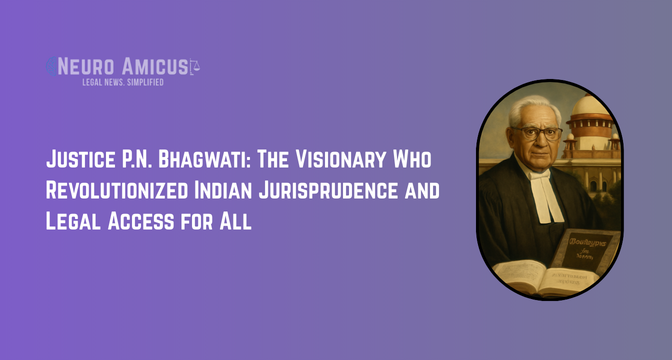
Banner Image Description: A dignified portrait of Justice P.N. Bhagwati seated in judicial robes, with a backdrop of the Indian Supreme Court building and an open Constitution of India, symbolizing his profound impact on constitutional law and justice.
This comprehensive overview reflects Justice P.N. Bhagwati’s monumental legacy as a visionary jurist who reshaped Indian law and the judiciary, leaving an enduring imprint on social justice and constitutional rights.
