

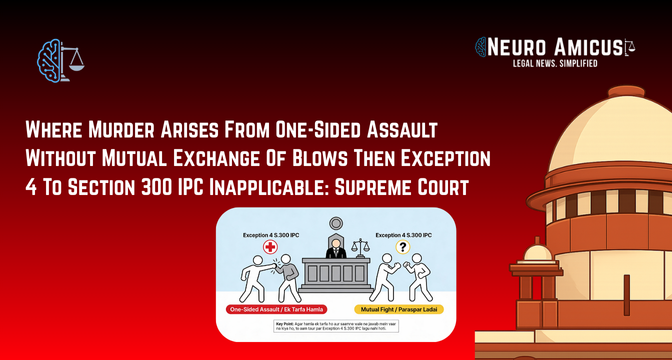
News Summary:
In Surender Kumar v. State of Himachal Pradesh, the Supreme Court dismissed an appeal confined to the question whether the appellant’s conviction under Section 302 IPC could be reduced by invoking the Exceptions to Section 300, particularly Exceptions 2, 4 and, alternatively, 1. The deceased suffered four knife blows on vital parts of the body, severing major arteries, and there was no defence evidence or credible suggestion in the appellant’s Section 313 CrPC statement that he acted in self‑defence or suffered any attack from the deceased. The Court held Exception 2 inapplicable because there was no material showing aggression by the deceased or threat to the accused’s person or property, nor any indication that the deceased was armed. Analysing Exception 4, the Bench reaffirmed that culpable homicide is downgraded only where there is absence of premeditation, a sudden fight, commission in the heat of passion, and no undue advantage or cruel conduct; a “fight” requires mutual physical assault and not a mere verbal quarrel. Relying on Bhagwan Munjaji Pawade v. State of Maharashtra and Awadhesh Kumar v. State of U.P., the Court reiterated that Exception 4 does not apply where an armed accused inflicts multiple serious injuries on an unarmed victim in a one‑sided attack. The Court also rejected Exception 1 (grave and sudden provocation) for lack of evidence that the appellant lost self‑control to that degree, and therefore upheld the murder conviction and sentence under Section 302 IPC.
2. Legal provisions relied on
(a) Section 300 IPC, Exception 4 – Indian Penal Code, 1860
Text: Exception 4 to Section 300 IPC provides in substance that culpable homicide is not murder if it is committed without premeditation, in a sudden fight, in the heat of passion upon a sudden quarrel, and without the offender having taken undue advantage or having acted in a cruel or unusual manner.
Simple explanation: Exception 4 operates as a partial defence that reduces murder to culpable homicide not amounting to murder when all four conditions coexist: no pre‑planning, a genuine sudden fight following a sudden quarrel, loss of self‑control in the heat of passion, and a proportional response that is neither cruel nor exploitative of the situation.
Relevance: The entire news centers on whether this Exception could mitigate the appellant’s liability from Section 302 to Section 304 IPC, and the Court’s ruling that it cannot apply in one‑sided, cruel knife attacks without mutual exchange of blows.
(b) Section 300 IPC, Exception 2 – Indian Penal Code, 1860
“Culpable homicide is not murder if the offender, in the exercise in good faith of the
right of private defence of person or property, exceeds the power given to him by law and causes the death of the person against whom he is exercising such right of defence without premeditation, and without any intention of doing more harm than is necessary for the purpose of such defence.”
Gist : Exception 2 to Section 300 IPC states in essence that culpable homicide is not murder if the offender exceeds the right of private defence, acting in good faith and without premeditation, and does more harm than necessary for such defence.
Simple explanation: This Exception applies where a person genuinely exercises self‑defence but unintentionally causes death by exceeding the limits of lawful defence, thereby reducing the offence from murder to culpable homicide not amounting to murder.
Relevance: The appellant argued that the homicide occurred while exceeding the right of private defence; the Supreme Court found no factual foundation for self‑defence, holding Exception 2 inapplicable.
(c) Section 300 IPC, Exception 1 – Indian Penal Code, 1860
“When culpable homicide is not murder.—Culpable homicide is not murder if the offender, whilst deprived of the power of self-control by grave and sudden provocation, causes the death of the person who gave the provocation or causes the death of any other person by mistake or accident.”
Gist : Exception 1 to Section 300 IPC essentially covers cases where culpable homicide is committed under grave and sudden provocation, causing the offender to lose self‑control, subject to specified limitations.
Simple explanation: If a person, deprived of self‑control by grave and sudden provocation from the victim, kills that person before regaining composure, the law may treat the act as culpable homicide not amounting to murder instead of murder.
Relevance: Defence counsel sought to rely, in the alternative, on provocation arising from a prior quarrel; the Court held that the evidence did not show such grave and sudden provocation as to deprive the accused of self‑control.
(d) Section 302 IPC – Punishment for murder
“Whoever commits murder shall be punished with death, or [imprisonment for life], and shall also be liable to fine.”
Gist: Section 302 IPC prescribes the punishment for murder, typically death or imprisonment for life and fine.
Simple explanation: Once a homicide qualifies as “murder” under Section 300 IPC and no exception applies, Section 302 lays down the penal consequences, which the Court in this case declined to dilute.
Relevance: The appellant was convicted under Section 302 IPC, and the appeal challenged only whether a lesser offence (for example under Section 304 IPC) could be substituted.
(e) Section 313 CrPC – Code of Criminal Procedure, 1973
“Power to examine the accused.—(1) In every inquiry or trial, for the purpose of enabling the accused personally to explain any circumstances appearing in the evidence against him, the Court—(a) may at any stage, without previously warning the accused put such questions to him as the Court considers necessary;
(b) shall, after the witnesses for the prosecution have been examined and before he is called on for his defence, question him generally on the case: Provided that in a summons-case, where the Court has dispensed with the personal attendance of the accused, it may also dispense with his examination under clause (b).
(2) No oath shall be administered to the accused when he is examined under sub-section (1).
(3) The accused shall not render himself liable to punishment by refusing to answer such questions, or by giving false answers to them.
(4) The answers given by the accused may be taken into consideration in such inquiry or trial, and put in evidence for or against him in any other inquiry into, or trial for, any other offence which such answers may tend to show he has committed.
[(5) The Court may take help of Prosecutor and Defence Counsel in preparing relevant questions which are to be put to the accused and the Court may permit filing of written statement by the accused as sufficient compliance of this section.]”
Gist: Section 313 CrPC empowers the court to question the accused generally on the case after the prosecution evidence, enabling the accused to explain circumstances appearing in evidence.
Simple explanation: This provision allows an accused to put forward his explanation or defence in his own words; silence or mere denial may weaken claims to statutory exceptions that require factual foundations.
Relevance: The Supreme Court expressly noted that in the appellant’s Section 313 statement there was no plea of self‑defence or allegation that the deceased had attacked or harmed him, undermining reliance on Exceptions 1, 2 or 4.
3. Core legal topic
Core topic: Distinction between murder and culpable homicide not amounting to murder, specifically the scope of Exception 4 to Section 300 IPC in cases of one‑sided lethal assaults and the evidentiary threshold for invoking Exceptions 1, 2 and 4.
4. Contextual understanding
The law of homicide in India has historically revolved around carefully distinguishing murder from culpable homicide not amounting to murder, with Section 300 IPC and its exceptions forming the central doctrinal framework since 1860. The legislative intent behind the Exceptions was to temper the rigidity of the murder provision by recognising human frailty in situations like grave provocation, exceeding self‑defence or sudden fights, while still condemning disproportionate, cruel or premeditated violence. Constitutional values under Articles 14 and 21 subtly inform judicial application, requiring proportionality, fairness and individualised sentencing in homicide cases. Globally, many common‑law jurisdictions pursue similar gradations, distinguishing between degrees of murder and manslaughter based on intent, provocation and self‑defence, though India relies on the IPC’s structured set of exceptions rather than a degree‑based model. Comparative jurisprudence in England, Canada and Australia on “provocation” and “loss of self‑control” has influenced Indian courts’ emphasis on objective standards and evidence‑based scrutiny when an accused claims to have acted in the heat of passion or self‑defence. The present decision fits into a broader trend of tightening the gateway to these mitigating exceptions in cases involving repeated lethal blows on unarmed victims.
5. Judicial interpretation
Over time, Indian courts have developed clear principles that Exceptions 1, 2 and 4 to Section 300 IPC are narrow, fact‑sensitive mitigations, not broad escape routes from murder liability, and the burden to bring a case within them lies on the accused on a preponderance of probabilities. Exception 4 has been interpreted to require a conjunctive satisfaction of four conditions: absence of premeditation, a genuine “sudden fight” following a “sudden quarrel”, commission in the heat of passion, and an absence of undue advantage or cruel/unusual conduct, with “fight” consistently read as mutual physical aggression rather than unilateral attack. In Bhagwan Munjaji Pawade v. State of Maharashtra, the Supreme Court considered an unarmed victim who suffered multiple fatal axe blows from an armed accused amid a sudden quarrel, and held that there was no “fight” because a fight presupposes bilateral exchange of blows, so Exception 4 did not apply and conviction under Section 302 IPC was proper. The Court emphasised that repeated use of a formidable weapon against an unarmed victim in such circumstances is inherently cruel and shows the accused taking undue advantage, thereby failing the proportionality limb of Exception 4. In Awadhesh Kumar v. State of U.P., which followed Bhagwan Pawade, the Supreme Court reiterated that where an accused is armed and the victim is unarmed, and there is no real exchange of blows or mutual combat, Exception 4 cannot be pressed into service merely because there was some quarrel or verbal altercation preceding the assault. The uploaded judgment in Surender Kumar v. State of Himachal Pradesh builds directly on these precedents: the Court noted four knife blows on vital parts, severing major arteries, against an unarmed victim, absence of any evidence that the victim attacked or injured the accused, and a Section 313 statement limited to denial, and therefore excluded Exception 2 for lack of any factual foundation of self‑defence and refused Exception 4 because there was no mutual fight or exchange of blows and the attack was cruel. The Court also considered Exception 1 but found no credible material indicating such grave and sudden provocation as to deprive the accused of self‑control, especially in light of the severity and localisation of the injuries. This decision thus consolidates a line of authority clarifying that Exception 4 is inapplicable in one‑sided, weapon‑based assaults on unarmed victims, reaffirming doctrinal tests grounded in mutuality of combat and proportionality of response. No prominent contradictory Supreme Court judgment presently endorses applying Exception 4 to comparable one‑sided, multi‑blow knife or axe attacks; where Exception 4 has been applied in other cases, they typically involve clear evidence of a two‑sided fight and less extreme or localised violence.
6. Critical analysis
The present jurisprudence on Exception 4 demonstrates strength in its insistence on objective indicators of mutual combat and proportionality, which protects vulnerable, unarmed victims from ex post facto dilution of liability through loosely pleaded “sudden fight” narratives. By demanding evidence of bilateral exchange of blows and scrutinising the number, location and ferocity of injuries, courts reduce scope for misuse of the Exception in cases of domestic or street violence where the weaker party cannot retaliate. However, the law’s rigidity can produce harsh outcomes in borderline scenarios where provocation is real but poorly documented, especially in under‑investigated rural cases, and the high threshold for Exceptions 1 and 4 may leave limited room for nuanced gradation between murder and culpable homicide. Judicial language around “cruelty” also remains somewhat open‑textured, leaving room for inconsistency across benches, despite recent attempts at clarification.
7. Conclusion
The Surender Kumar ruling underscores that one‑sided lethal attacks with repeated knife blows on unarmed victims will ordinarily attract full murder liability under Section 302 IPC, without the shelter of Exception 4. Trial courts can be expected to apply heightened scrutiny to claims of “sudden fight” and insist on concrete evidence of mutual physical aggression before reducing charges to culpable homicide not amounting to murder. Defence strategies relying on Exceptions 1, 2 or 4 will need to be supported by timely cross‑examination, medical evidence and a coherent Section 313 narrative rather than bare assertions at the appellate stage. Prosecutors may increasingly argue, on the strength of this precedent, that repeated use of deadly weapons on vital parts invariably reflects cruelty and undue advantage, foreclosing Exception 4. Sentencing courts are likely to continue distinguishing more sharply between genuine mutual fights and unilateral assaults, with significant implications for charge‑framing and plea‑bargaining in homicide trials. The decision may also influence academic and law‑reform debates on whether India should adopt more flexible homicide gradations or retain the existing exception‑based model.
