

News summary
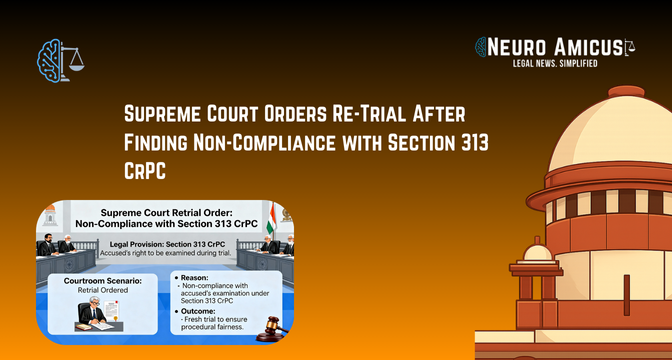
The Supreme Court of India, in its recent judgment in Chandan Pasi & Ors. v. State of Bihar (2025 INSC 1371), has set aside the life sentences of three individuals due to non-compliance with Section 313 of the Code of Criminal Procedure (CrPC) during their criminal trial for murder. The Court found that the statements recorded from the accused under Section 313 were mere “carbon copies” and failed to address each material circumstance that had arisen during the prosecution—an essential safeguard to ensure the accused can respond to allegations specifically. This generic and mechanical approach constituted a serious violation of fair trial guarantees and natural justice. The Supreme Court, criticizing both the trial judge and the prosecution for neglecting these duties, remanded the matter for a fresh trial, directing the process to recommence from the proper stage of Section 313 examination. The decision reiterates that substantive, not skeletal, compliance with Section 313 is mandatory, as established in multiple past precedents. Only the three appellants are awarded this relief, with the findings not impacting the other accused in the case. The trial court is directed to restart proceedings within four months of the Supreme Court’s order.
Legal Provisions Relied On
Code of Criminal Procedure, 1973, Section 313
Text:
“Power to examine the accused.—
(1) In every inquiry or trial, for the purpose of enabling the accused personally to explain any circumstances appearing in the evidence against him, the Court—
(a) may at any stage put such questions as it considers necessary;
(b) shall, after all witnesses for the prosecution have been examined and before the accused is called on for his defence, question him generally on the case.
…
(4) The answers given may be taken into consideration in such inquiry or trial, and put in evidence for or against him …”
Explanation: This provision mandates that trial courts must put to the accused every significant incriminating circumstance arising in the evidence, allowing the accused to clarify or respond directly.
Relevance: Section 313 was central to this case, as its non-compliance denied the accused a fair chance to respond, undermining the legitimacy of the conviction.
Indian Penal Code, 1860, Section 302, Section 34
- These provisions relate to punishment for murder (Section 302) and joint liability (Section 34), relevant as the conviction was for these offences.
Core Legal Topic
Fair Trial and the Right of Accused to Be Heard (Section 313 CrPC compliance in criminal procedure)
Contextual Understanding
The right to a fair trial is deeply embedded in Indian criminal jurisprudence, mirroring principles enshrined in Article 21 of the Constitution—“No person shall be deprived of his life or personal liberty except according to procedure established by law.” Section 313 CrPC, as a statutory reflection of “audi alteram partem” (hear the other side), was enacted to ensure this constitutional mandate by requiring trial courts to directly confront the accused with every piece of evidence that could incriminate them. Globally, similar standards are seen in common law systems, with direct examination of the accused for clarifying evidence—albeit with differences in procedure. The Indian approach, however, makes this a strict obligation, not a mere form. Legislative intent is to guarantee real engagement and opportunity for defense—not a paper formality—even if it leads to delays or retrials if not properly done.
Judicial Interpretation
Over time, the Supreme Court has developed guiding principles to ensure Section 313’s fair implementation. The law is now clear that a trial judge must specifically put every material circumstance revealed during prosecution evidence to the accused, ensuring an opportunity for individualized response. In Sanatan Naskar v. State of West Bengal (2010 8 SCC 249), the Supreme Court emphasized that Section 313 is not a mere formality—it guarantees the accused an opportunity to explain any incriminating evidence, and the explanation does not require corroboration or oath. The statement cannot alone found a conviction, nor substitute for evidence but is meant to enhance veracity testing.
In Indrakunwar v. State of Chhattisgarh (2023 SCC OnLine SC 1364), principles were summarized: the questioning must be substantive, not mechanical; compliance is based on natural justice; and all circumstances not put to the accused must be excluded from consideration. The Raj Kumar v. State NCT of Delhi (2023 17 SCC 95) line—reiterated recently in Aejaz Ahmad Sheikh v. State of U.P. (2025 SCC OnLine SC 913)—makes clear that failure to put material circumstances is a serious irregularity vitiating the trial if prejudice ensues; if not, the error could be curable. However, the longer the delay, the harder cure becomes, sometimes warranting retrial.
In the Chandan Pasi case itself, which referenced the above, the Supreme Court found the Section 313 statements to be “carbon copies”, wholly generic, and thus not satisfying the standard required. The trial court and prosecution both failed in their duties, necessitating a partial retrial starting from proper Section 313 compliance. The court reinforced that prosecution’s duty is to assist the court’s justice mandate—not merely secure convictions. This line was supported by reference to Sovaran Singh Prajapati v. State of U.P. (2025 SCC OnLine SC 351).
No significant contradictory judgments exist; however, courts occasionally distinguish curable irregularities from fatal ones based on demonstrated prejudice.
Critical Analysis Context
While Section 313 CrPC provides a powerful guarantee against one-sided convictions, its effectiveness varies greatly. On one hand, it upholds fundamental fairness and is an important corrective when prosecution evidence is ambiguous or circumstantial. Nonetheless, variance in judicial approach means some courts treat it as a formality, resulting in mechanical compliance—this case demonstrates such pitfalls. There is a gap between articulated ideals and consistent practical enforcement. Judicial trends now increasingly hold that only substantial, not technical, compliance safeguards justice—yet consistent training and oversight remain needed at the trial court level to avoid routine lapses.
Conclusion
The Supreme Court’s direction to restart the trial from the Section 313 stage underlines the gravity of compliance failures and serves as a strong reminder to lower courts regarding their duties. Prosecutors are cautioned about their role as officers of justice, not mere agents for conviction. This judgment will likely lead to stricter scrutiny of Section 313 compliance, possibly increased retrials where mechanical approaches are seen, and administrative measures to ensure robust implementation. Legal practitioners and trial judges must now treat Section 313 questioning as a substantive engagement with the accused, not as a box-ticking exercise. Over time, this will strengthen procedural fairness and reduce wrongful convictions—but courts must balance the need for retrials against the rights of victims and society for timely justice.
