

News summary
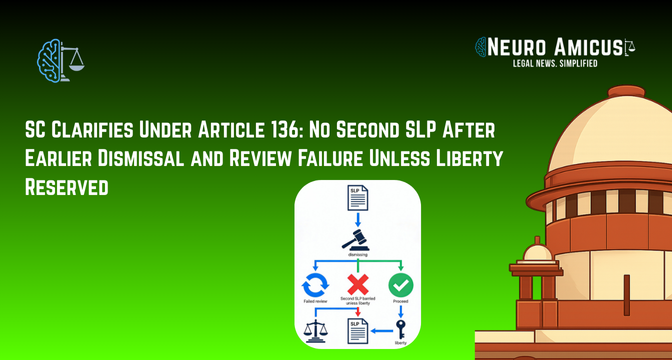
The news concerns a recent Supreme Court judgment in Kangra Central Cooperative Bank Ltd v Kangra Central Cooperative Bank Pensioners Welfare Association (Regd.) & Ors., where the Court held that a second Special Leave Petition (SLP) under Article 136 is not maintainable after dismissal of an earlier SLP and failure of a High Court review, unless the first dismissal order expressly reserves liberty to approach the Supreme Court again. The case arose from a long‑running dispute over pensionary benefits of retired employees of Kangra Central Cooperative Bank, where a Single Judge had allowed the pension claims, a Division Bench later dismissed the writ as not maintainable, and the matter repeatedly reached the Supreme Court through appeals and SLPs. An initial SLP against the Division Bench judgment was dismissed by a non‑speaking order; a subsequent miscellaneous application for recall was withdrawn with liberty only to seek review before the High Court, not to re‑approach the Supreme Court. After the High Court dismissed the review, the Bank filed a fresh SLP directly targeting the review dismissal, prompting a preliminary objection to maintainability. The Supreme Court, relying on precedents such as Upadhyay & Co. v State of U.P., Bussa Overseas, T K David, Satheesh V.K., Kunhayammed, and Khoday Distilleries, treated a second SLP as contrary to public policy and the principle of finality in litigation, and dismissed it in limine. The Court clarified that while a review before the High Court remains open after a non‑speaking dismissal of an SLP, the same party cannot, in the absence of specific liberty, return with a fresh SLP after losing in review, as this would amount to re‑litigation and undermine rule of law. Exercising Article 142 to avoid further disputes, the Court confined the operative liability of the Bank to a closed class of 186 pensioners and spouses, explicitly stating that this factual direction is not a binding precedent, while affirming the broader doctrinal bar on successive SLPs.
Legal provisions relied on
- Article 136, Constitution of India – Special leave to appeal by the Supreme Court
Text :
“136. (1) Notwithstanding anything in this Chapter, the Supreme Court may, in its discretion, grant special leave to appeal from any judgment, decree, determination, sentence or order in any cause or matter passed or made by any court or tribunal in the territory of India.
(2) Nothing in clause (1) shall apply to any judgment, determination, sentence or order passed or made by any court or tribunal constituted by or under any law relating to the Armed Forces.”
Simple explanation: Article 136 confers a wide discretionary power on the Supreme Court to grant special leave to appeal from virtually any decision of any court or tribunal (except Armed Forces courts), but it is not a matter of right for litigants.
Relevance: The entire controversy concerns the permissible use and limits of Article 136, specifically whether a litigant can file a second SLP after dismissal of an earlier SLP and failure of a review, absent express liberty. - Article 142, Constitution of India – Enforcement of decrees and orders of Supreme Court and orders as to discovery, etc.
Text (verbatim, relevant part, official English):
“142. (1) The Supreme Court in the exercise of its jurisdiction may pass such decree or make such order as is necessary for doing complete justice in any cause or matter pending before it…”
Simple explanation: Article 142 empowers the Supreme Court to make any order needed to do complete justice between the parties in a pending case, even crafting tailored, case‑specific directions.
Relevance: The Court used Article 142 to cap the Bank’s liability to 141 pensioners and 45 spouses (total 186) in this particular dispute, while clarifying that this factual direction is not a precedent and does not dilute the legal rule on second SLPs. - Order XLVII Rule 7, Code of Civil Procedure, 1908 – Order of rejection not appealable; objections to order granting application
Text (verbatim, official English):
“Order XLVII Rule 7. Order of rejection not appealable—Objections to order granting application.—(1) An order of the Court rejecting the application shall not be appealable; but an order granting an application may be objected to on the ground that the application for review was—
(a) not maintainable, or
(b) not filed within the time limited therefor,
and such objection may be taken at once by an appeal from the order granting the application or in any appeal from the decree or order finally passed or made in the suit.”
Simple explanation: If a review petition is dismissed, the order refusing review cannot itself be appealed; the challenger must, in principle, attack the original decree or order, not the review order.
Relevance: The Court invoked this provision to explain why, after a failed review and an earlier dismissed SLP, a fresh SLP challenging either only the review order or the main judgment is not maintainable in the absence of explicit liberty. - Order XXIII Rule 1, Code of Civil Procedure, 1908 – Withdrawal of suit or abandonment of claim
Text (verbatim, relevant portion as quoted in the judgment):
“Order 23, rule 1 …
(4) Where the plaintiff—
(a) abandons any suit or part of a claim under sub‑rule (1), or
(b) withdraws from a suit or part of a claim without the permission referred to in sub‑rule (3),
he shall be liable for such costs as the court may award and shall be precluded from instituting any fresh suit in respect of such subject‑matter or such part of the claim.”
Simple explanation: If a party withdraws a suit without getting permission to file afresh, that party is barred from bringing a new suit on the same cause of action.
Relevance: Through Upadhyay & Co. and Sarguja Transport, this “public policy” rule is extended by analogy to writ petitions and SLPs, supporting the bar against second SLPs after unconditional withdrawal or dismissal without liberty. - Doctrine of merger and review jurisdiction (judge‑made constitutional doctrine under Articles 136, 226, 227)
Text (doctrinal, as extracted in judgment):
The Court summarized the settled position from Kunhayammed and Khoday Distilleries that dismissal of an SLP, whether speaking or non‑speaking, without grant of leave, does not attract the doctrine of merger, and a review before the High Court remains maintainable.
Simple explanation: Only when the Supreme Court grants leave and decides an appeal does the lower court’s order merge into the Supreme Court’s decision; if an SLP is dismissed at the threshold, the High Court’s order survives independently, and review can still be entertained there.
Relevance: This doctrine explains why the review before the Himachal Pradesh High Court was legally open despite the earlier SLP dismissal, but also why a further second SLP after that review could not be entertained without express liberty.
Core legal topic
Core legal topic:
Appellate procedure under Article 136, finality of litigation, and bar on successive Special Leave Petitions (abuse of process/public policy).
Contextual understanding
The power under Article 136 was framed as a residuary, discretionary jurisdiction to correct grave injustice, not as a routine tier of appeal, and historically the Supreme Court has guarded it through self‑imposed restraints. Over time, a vast SLP docket led the Court to evolve doctrines to curb repetitive and abusive filings, including the doctrine of merger, limits on review after SLPs, and analogical use of civil procedure principles to constitutional remedies. Decisions like Sarguja Transport extended the bar on refiling (Order XXIII Rule 1 CPC) from civil suits to writs, emphasising public policy and prevention of “bench‑hunting”; Upadhyay & Co., Bussa Overseas and later cases imported the same logic to SLPs. The legislative text of Article 136 is sparse; much of the nuanced framework is judicially crafted, drawing constitutional support from rule of law and the need for finality in adjudication. Comparative jurisdictions similarly restrict serial appeals and collateral attacks to preserve judicial economy, such as leave requirements in the UK Supreme Court and certiorari limits in the US Supreme Court, though India’s Article 136 remains uniquely broad in its textual scope. The present ruling consolidates a line of Indian precedents that prioritize finality over maximal access to the Supreme Court in repeat‑litigation scenarios.
Judicial interpretation
Over decades, the Supreme Court has developed a layered jurisprudence on Article 136 to balance its wide text with systemic constraints, focusing on doctrines of merger, review, and finality. In Kunhayammed v State of Kerala and Khoday Distilleries Ltd v Mahadeshwara SSK Ltd, three‑judge benches held that dismissal of an SLP without grant of leave—whether by a speaking or non‑speaking order—does not trigger merger; hence, the High Court’s judgment persists, and a review there remains maintainable. This principle underpins the present case: review in the Himachal Pradesh High Court was open despite the earlier SLP dismissal.
Bussa Overseas Properties (P) Ltd v Union of India treated long‑standing practice as a “precedential principle” that an SLP filed only against an order rejecting review, without challenging the main judgment, is not entertainable because no effective relief can be granted once the main judgment stands untouched. T K David v Kuruppampady Service Cooperative Bank Ltd reaffirmed that, after dismissal of an SLP against the main High Court judgment, a subsequent SLP only against rejection of review is not maintainable, since the main judgment has attained finality and cannot be indirectly reopened. These rulings are expressly relied upon in Kangra Central Cooperative Bank to sustain the preliminary objection to the second SLP.
In Upadhyay & Co. v State of U.P., the Court analogised Order XXIII Rule 1 CPC to SLPs, holding that once an SLP against a particular order is withdrawn without liberty to file afresh, a subsequent SLP challenging the same order is impermissible, anchoring this in public policy against endless litigation and bench‑hunting. Sarguja Transport Service v State Transport Appellate Tribunal earlier applied the same rationale to writ petitions under Article 226, emphasising that unconditional withdrawal exhausts the remedy in that forum. These public‑policy foundations are explicitly endorsed in the new judgment, which quotes the Latin maxim interest reipublicae ut sit finis litium to justify the bar on repetitive SLPs.
More recently, Satheesh V.K. v Federal Bank Ltd directly addressed whether a “second in the series” SLP is maintainable where an earlier SLP was withdrawn without liberty, followed by a failed review; the Court, reading Upadhyay together with Sarguja Transport, held that a second SLP is not maintainable either against the main judgment or against the review order. Kangra Central Cooperative Bank treats Satheesh as the “clincher”, applying the same logic where the first SLP was dismissed on merits (non‑speaking) and a recall application was withdrawn with liberty only to seek review in the High Court, with no liberty to re‑approach the Supreme Court.
An apparent counter‑current emerged in S Narahari v S.R. Kumar, where a two‑judge bench, in the context of an SLP dismissed as withdrawn with liberty to seek review, opined that a fresh SLP may still persist because a non‑speaking dismissal does not create res judicata and does not constitute “law” under Article 141. However, Satheesh and the present judgment distinguish S Narahari on facts (initial SLP withdrawn with review liberty) and emphasise that mere reference to a larger bench in S Narahari does not unsettle earlier coordinate‑bench law like Upadhyay unless expressly overruled. Relying on Union Territory of Ladakh v J&K National Conference, the Court reiterates that High Courts and smaller benches must follow existing precedent even if a reference is pending elsewhere.
In Kangra Central Cooperative Bank itself, the Court thus synthesises these strands: (a) review is available after non‑speaking SLP dismissal, (b) no appeal lies from an order rejecting review (Order XLVII Rule 7 CPC), and (c) public policy, as developed in Upadhyay, Bussa Overseas, T K David and Satheesh, bars a second SLP after an earlier SLP has been dismissed and review has failed, unless the Supreme Court has expressly reserved liberty for a fresh approach. On the merits of the pension dispute, the Court consciously refrains from re‑adjudicating substantive issues, focusing instead on maintainability; yet, to avoid further litigation, it uses Article 142 to confine the Bank’s liability to 186 identified beneficiaries.
Overall, judicial interpretation now firmly treats Article 136 as a one‑time extraordinary doorway per order, with narrow exceptions where liberty is clearly recorded; litigants cannot use review and serial SLPs to secure multiple “bites at the cherry”.
Critical analysis
The present framework effectively safeguards finality, judicial economy, and institutional legitimacy by preventing endless SLP cycles, especially significant in a system already burdened by massive arrears. The reliance on public policy and CPC analogies brings coherence across civil, writ, and constitutional jurisdictions, discouraging tactical withdrawals and bench‑hunting. However, heavy dependence on judge‑made doctrine, rather than express constitutional or statutory text, can create complexity and occasional confusion, as seen in tensions between S Narahari and later clarifications. Strict bars on second SLPs may, in hard cases, risk foreclosing correction of serious errors where initial dismissal orders are very brief or where counsel strategy was flawed, placing great weight on how precisely liberty is recorded. The Court’s resort to Article 142 to tailor relief in Kangra Bank shows sensitivity to equities but also underscores that individualised justice may sometimes sit uneasily with rigid procedural finality.
Conclusion
The judgment significantly tightens the procedural boundary around Article 136 by confirming that a second SLP, following dismissal of the first and failure of a High Court review, is barred unless explicit liberty to return is granted at the earlier stage. Litigants and counsel must now treat the first SLP as their primary and often only entry point, ensuring that any withdrawal or adverse dismissal order clearly records any intended liberty; otherwise, the door to the Supreme Court will typically close after review. High Courts are reminded to decide reviews on their own limited parameters without feeling constrained merely because an SLP was dismissed, since merger does not occur without grant of leave. For institutions like cooperative banks, the case illustrates that strategic missteps in appellate procedure can lock in heavy financial consequences, mitigated here only by a case‑specific Article 142 order. Future litigation is likely to see more preliminary objections on maintainability of successive SLPs, with courts scrutinising earlier orders and the presence or absence of recorded liberty. Legislatively, there may be scope to codify aspects of this judge‑made law, but until then, the precedents in Upadhyay, Bussa Overseas, T K David, Satheesh, and Kangra Central Cooperative Bank will govern practice. The ruling also signals a broader judicial trend of reinforcing finality and discouraging re‑litigation as a facet of rule of law in India’s appellate system.
