

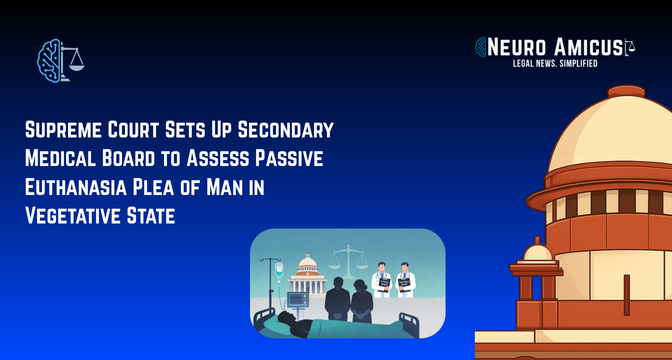
News summary
The news concerns the Supreme Court’s decision to constitute a Secondary Medical Board at AIIMS, New Delhi, to reassess a father’s plea for passive euthanasia for his 32‑year‑old son, Harish Rana, who has been in a persistent vegetative state with 100% quadriplegic disability for around 12–13 years after a fall from a building. Earlier, pursuant to directions under the 2018 Constitution Bench decision in Common Cause v. Union of India (as modified in 2023), a Primary Medical Board examined Harish at his home and opined that he has intact brainstem function but is in a vegetative state, completely dependent on tracheostomy and gastrostomy, with widespread contractures and bed sores, and that chances of recovery are “negligible”. Taking note of this “pathetic” condition, a Bench of Justices J.B. Pardiwala and K.V. Viswanathan held that the matter must now move to the next statutory‑guideline stage by asking the AIIMS Director to form a Secondary Medical Board to independently examine whether life‑sustaining treatment, including clinically assisted nutrition and hydration, can be withdrawn in Harish’s best interests. The Court fixed a short timeline (report by 17 December 2025 and listing on 18 December) and reiterated that passive euthanasia, not active euthanasia, is in issue, thereby closely tracking the safeguards and process laid down in Common Cause (advance directives, medical boards, consent of next of kin, and judicial oversight) while also responding to the applicant’s broader prayers for systemic directions to States and High Courts on implementing those guidelines.
Legal provisions relied on
- Constitution of India, Article 21 – Protection of life and personal liberty
Text: “No person shall be deprived of his life or personal liberty except according to procedure established by law.”
Simple explanation: Article 21 guarantees the right to life and personal liberty, which the Supreme Court has interpreted to include the right to live with dignity and, in certain circumstances, the right to die with dignity.
Relevance: Passive euthanasia and withdrawal of life support are justified in India as flowing from the Article 21 right to die with dignity, subject to strict procedure. - Constitution of India, Article 226 – Power of High Courts to issue certain writs
Text (verbatim – key opening clause): “Notwithstanding anything in article 32, every High Court shall have power, throughout the territories in relation to which it exercises jurisdiction, to issue to any person or authority, including in appropriate cases, any Government, within those territories directions, orders or writs…”
Simple explanation: Article 226 empowers High Courts to issue writs and directions for enforcement of fundamental rights and other legal rights against public authorities.
Relevance: The litigation journey began with a writ petition under Article 226 before the Delhi High Court seeking constitution of a medical board and permission for passive euthanasia, later reaching the Supreme Court in SLP and miscellaneous jurisdiction. - Indian Penal Code, 1860 – Sections 299 & 300 (context of culpable homicide / not directly applied but historically relevant)
Text : “Except in the cases hereinafter excepted, culpable homicide is murder, if the act by which the death is caused is done with the intention of causing death…”
Simple explanation: These provisions historically framed the criminal law context in which euthanasia was often equated with homicide or abetment of suicide, prompting judicial carve‑outs for passive euthanasia.
Relevance: In Aruna Shanbaug and Common Cause, the Court distinguished passive euthanasia (lawful withdrawal of futile treatment) from criminal acts causing death, shaping the background to the current case. - Indian Penal Code, 1860 – Sections 299, 300, 302, 304, 306 (again, contextual)
Text ( extract from Section 306): “If any person commits suicide, whoever abets the commission of such suicide, shall be punished with imprisonment of either description for a term which may extend to ten years, and shall also be liable to fine.”
Simple explanation: These provisions criminalise homicide and abetment of suicide; courts have had to ensure that permissible passive euthanasia does not amount to an offence under these sections.
Relevance: The passive euthanasia framework is crafted to avoid characterising withdrawal of futile treatment, when lawfully authorised, as abetment of suicide or culpable homicide. - Common Cause (A Registered Society) v. Union of India, (2018) 5 SCC 1 – directions (para 199.1 and related)
Text (verbatim – as reproduced in the SC order): “In cases where the patient is terminally ill and undergoing prolonged treatment in respect of ailment which is incurable or where there is no hope of being cured, the physician may inform the hospital which, in turn, shall constitute a Primary Medical Board in the manner indicated earlier… During the discussion, the patients next of kin/next friend/guardian shall be apprised of the pros and cons of withdrawal or refusal of further medical treatment to the patient and if they give consent in writing, then the Primary Medical Board may certify the course of action to be taken preferably within 48 hours… Their decision will be regarded as a preliminary opinion.”
Simple explanation: Common Cause laid down a detailed procedure for passive euthanasia and advance directives, requiring a Primary Medical Board, consultation with family, and certification as a preliminary step.
Relevance: The present order explicitly invokes para 199.1 and treats the Primary Medical Board’s report as a trigger for moving to the Secondary Board stage. - Miscellaneous Application No. 1699 of 2019 in W.P. (C) No. 215 of 2005 – Order dated 24.01.2023 modifying Common Cause guidelines
Text (verbatim – extract as quoted): “In cases where the patient is terminally ill and undergoing prolonged treatment… the physician may inform the hospital, which, in turn, shall constitute a Primary Medical Board… The Primary Medical Board shall discuss with the family physician, if any, and the patients next of kin/next friend/guardian… and if they give consent in writing, then the Primary Medical Board may certify the course of action to be taken preferably within 48 hours…”
Simple explanation: The 2023 order simplified and made more workable the 2018 guidelines, including timelines and clearer roles for primary and secondary boards.
Relevance: The present news is an application seeking application and further implementation of these modified guidelines, including constitution of both boards and directions to States/UTs. - Common Cause (A Regd. Society) v. Union of India, 2023 14 SCC 131 (reported modification order) – Secondary Medical Board requirement
Text: The modification order provides that after the Primary Board’s preliminary opinion, a Secondary Medical Board of independent experts must consider the case and give its report before withdrawal of treatment, ensuring an additional safeguard.
Simple explanation: Two‑tier medical scrutiny (primary plus secondary board) is mandated before allowing passive euthanasia, to safeguard vulnerable patients.
Relevance: The Supreme Court’s current order requests the AIIMS Director to constitute this Secondary Board and report back, exactly following this structure.
Core legal topic
The core legal topic is “Passive euthanasia, advance directives, and the right to die with dignity under Article 21.”
Contextual understanding
Debate on euthanasia in India intensified with the Aruna Shanbaug case (2011), where the Supreme Court, while denying active euthanasia, cautiously allowed passive euthanasia under strict judicial control in cases of patients in a persistent vegetative state, thus beginning a jurisprudential distinction between killing and letting die. This evolved into a more rights‑oriented framework in Common Cause (2018), where a Constitution Bench held that the right to die with dignity is part of Article 21 and recognised advance medical directives (“living wills”), creating detailed guidelines for withholding or withdrawing life‑sustaining treatment. The legislative intent, inferred from constitutional principles and absence of specific euthanasia legislation, has been to balance sanctity of life with autonomy, bodily integrity, and dignity, while preventing abuse. Internationally, jurisdictions such as the Netherlands, Belgium, Canada, and some US states have more explicit statutory regimes for euthanasia or physician‑assisted dying, whereas many countries, including India, only permit some form of passive euthanasia through judicial or soft‑law frameworks, reflecting caution and ethical pluralism. The 2023 procedural simplification aims to make end‑of‑life decisions workable for doctors and families, while retaining multi‑layered safeguards.
Judicial interpretation
Judicial interpretation of passive euthanasia in India revolves around the principles of patient autonomy, best interests, proportionality of treatment, and a heightened duty to protect vulnerable persons, particularly where the person lacks capacity. In Aruna Ramachandra Shanbaug v. Union of India (2011), the Supreme Court was asked to permit withdrawal of life support for a nurse in a vegetative state for decades; the Court refused euthanasia in her specific case, emphasising the wishes of the hospital staff caring for her and holding that active euthanasia is illegal, but it nonetheless opened a narrow door for passive euthanasia under High Court supervision and with medical board opinions, establishing the core distinction between acts and omissions and introducing a “best interests” and “substituted judgment” style analysis. This framework was revisited and constitutionalised in Common Cause v. Union of India (2018) 5 SCC 1, where a Constitution Bench recognised the right to die with dignity as part of Article 21, upheld the validity of advance directives allowing withdrawal of life support, and laid down an elaborate procedure involving a Primary Medical Board, consultation with family, and judicial oversight, while insisting on strict safeguards to prevent coercion or error; the judgment harmonised previous right‑to‑die cases (Gian Kaur, P. Rathinam) by limiting criminalisation of suicide to active facilitation while allowing lawful medical non‑intervention. In Common Cause, Modification Order (24.01.2023; 2023 14 SCC 131), the Court simplified the 2018 process by, among other things, clarifying the constitution and timelines of Primary and Secondary Medical Boards, empowering hospital‑level decision‑making with streamlined involvement of district authorities or High Courts and reducing overly rigid formalities around registration of advance directives, thereby making the system practical while retaining two‑tier expert review and documented consent. The uploaded order in Harish Rana v. Union of India (Misc. App. No. 2238/2025 in SLP(C) No. 18225/2024) reflects the operationalisation of these doctrines: the Court records that Harish has 100% quadriplegic disability and has been in a vegetative condition for about 13 years, notes a detailed clinical evaluation by a neurologist, neurosurgeon, anaesthesiologist and plastic surgeon describing tracheostomy dependence, gastrostomy feeding, contractures, bed sores, and negligible chance of recovery, and characterises his situation as “pathetic”. Relying expressly on para 199.1 of Common Cause and the 2023 modification, the Bench directs constitution of a Primary Medical Board (already done) and now a Secondary Medical Board at AIIMS, treating the former’s opinion as preliminary and moving to the “next stage in the process”, with instructions that the Secondary Board’s report be submitted within a fixed time so the Court can decide whether life‑sustaining treatment, specifically clinically assisted nutrition and hydration, may be lawfully withheld or withdrawn. The order also takes cognisance of the applicant’s broader prayers for directions to States and High Courts on creating processes for nominating experts to Secondary Boards and receiving intimation of withdrawals, signalling the Court’s willingness to further refine the procedural architecture nationwide. There are no directly contradictory Supreme Court judgments on passive euthanasia post‑Common Cause; rather, earlier sceptical views on a right to die (e.g., parts of Gian Kaur) have been reconciled by treating passive euthanasia and living wills as falling within Article 21’s dignity component when implemented under stringent judicially crafted safeguards.
Critical analysis
The current legal framework’s strengths lie in its strong emphasis on dignity, autonomy, and multi‑layered safeguards—two medical boards, informed consent of next of kin, and, where necessary, judicial oversight—which reduce risks of abuse and provide moral reassurance to clinicians and families. However, the system still depends heavily on Supreme Court and High Court directions rather than a comprehensive statute, creating variability in implementation across States and hospitals, and often leading to delays in end‑of‑life decisions, as seen in the long timeline of Harish’s case. Procedural complexity and fear of criminal liability may make doctors reluctant to initiate withdrawal discussions, despite clear guidelines. Judicial trends are progressive in principle but case‑by‑case, leaving some uncertainty on operational details such as documentation standards, oversight mechanisms outside metros, and the interface with palliative care and disability rights frameworks.
Conclusion
The present order operationalises the passive euthanasia framework by moving Harish Rana’s case from primary to secondary medical scrutiny, aligning practice with the two‑tier medical‑board model outlined in Common Cause and refined in 2023. Practically, the AIIMS Secondary Board’s findings on prognosis, awareness, and futility will be central to whether the Court authorises withdrawal of clinically assisted nutrition and hydration. If withdrawal is allowed, the decision will underscore that, in extreme cases of prolonged vegetative state with negligible recovery prospects, the right to die with dignity can outweigh the default presumption in favour of preserving biological life, provided safeguards are followed. The case is also likely to prompt renewed directions to States and High Courts to fully implement medical‑board and notification mechanisms, reducing the need for repeat Supreme Court intervention. For hospitals, clearer processes may reduce legal risk and moral distress around end‑of‑life care. For families, the decision may offer a pathway to resolve long‑term limbo situations while ensuring independent expert scrutiny. Legislatively, the matter may revive calls for a dedicated statute on end‑of‑life decisions incorporating the Court’s jurisprudence.
